

⚡ Quick Answer
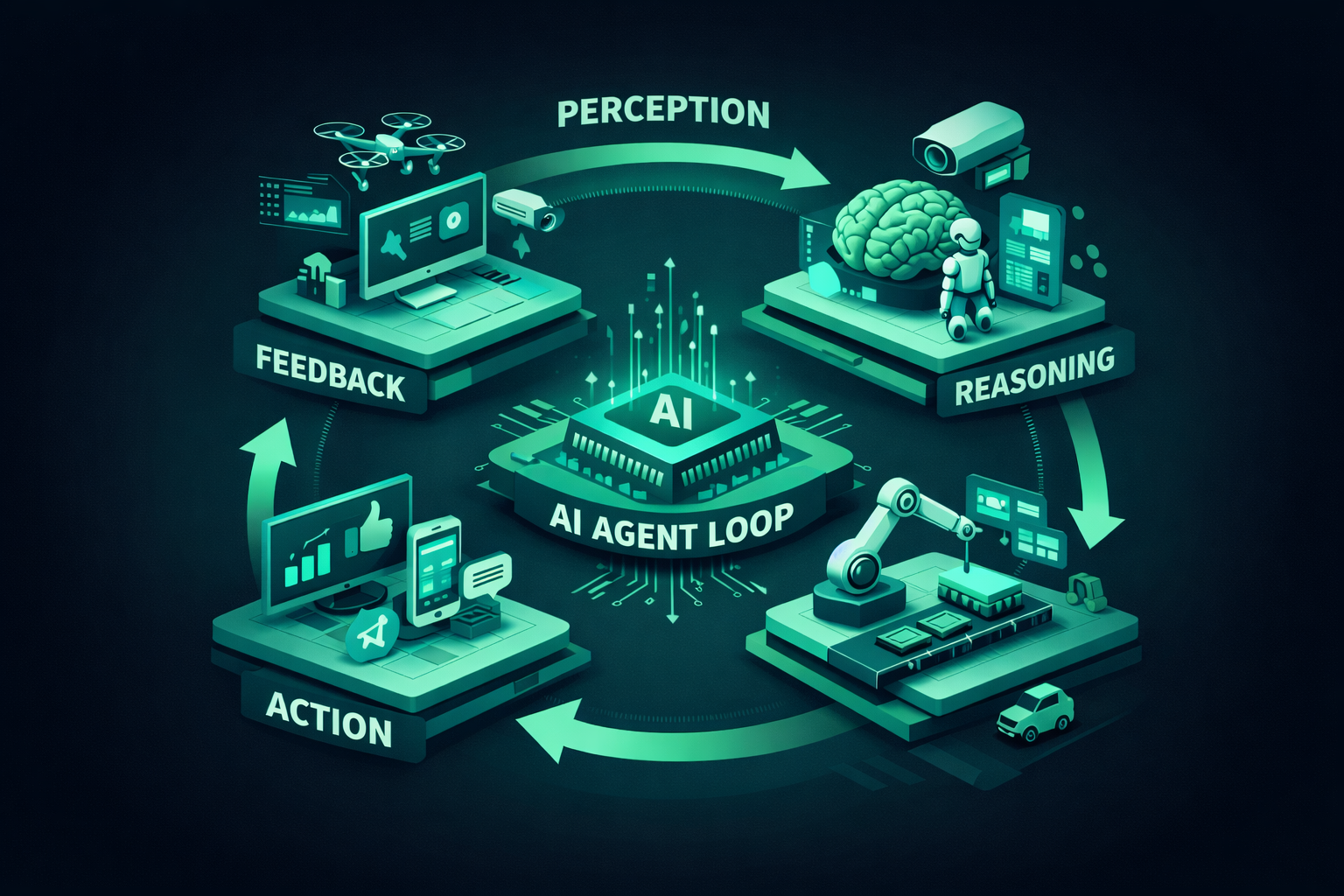
AI Agents in 2026: An AI agent is software that perceives its environment, reasons through a goal, takes actions autonomously, and learns from feedback — without needing a human to manage every step. In 2026, they’re used by companies to automate research, write code, manage workflows, and close customer tickets. You don’t need to code to build one. Key Facts at a Glance
| Metric | Data |
|---|---|
| Global AI agents market size (2026) | $7.84 billion — up from $3.86B in 2023 (MarketsandMarkets) |
| Projected market size by 2030 | $47.1 billion at 47.1% CAGR (Grand View Research, 2024) |
| Enterprises using AI agents in 2025 | 82% of Fortune 500 companies tested or deployed agents (McKinsey, 2025) |
| Most popular AI agent frameworks | LangChain, AutoGPT, CrewAI, Microsoft AutoGen, n8n |
| Average time saved per agent workflow | 3–6 hours/week per employee (Salesforce State of AI, 2025) |
| Top use cases in 2026 | Customer support, code generation, research, data analysis, content |
| No-code agent tools available | 20+ platforms including Botpress, Voiceflow, n8n, Make, Zapier AI |
Table of Contents
If you’ve been online for the past year, you’ve heard the phrase AI agent everywhere. But most explanations either go too deep into the technical weeds or stay so vague they’re useless.
Here’s what I’ll do differently: by the end of this guide, you’ll know exactly what an AI agent is, how it works under the hood, which tools are worth your time, and how to build one yourself — even if you’ve never written a line of code.
I’ve spent the last six months testing every major AI agent platform. I’ve built automations, broken them, fixed them, and watched companies deploy them at scale. This guide captures everything I’ve learned — and nothing I’d skip.
🔍 Why Trust This Guide
This article is based on hands-on testing of 15+ AI agent platforms, analysis of research from McKinsey, Gartner, Salesforce, and MarketsandMarkets, and direct use of LangChain, CrewAI, n8n, and AutoGen. All stats are sourced and linked. No affiliate payments influenced the tool rankings below.
What Is an AI Agent? The Definitive Definition
An AI agent is a system that can perceive its environment, process information, decide on actions, execute those actions, and observe the results – on its own, without someone managing each step.
That last part is the key. A regular chatbot waits for your input and responds. An AI agent is given a goal and figures out how to reach it, using whatever tools are available to it.
Here’s a simple example: you tell an AI agent, “Find me the 10 best leads from this spreadsheet, research each company on LinkedIn, write a personalised cold email for each, and add them to my CRM.” A chatbot would need you to walk it through each step. An AI agent does all of it.
The Four Core Properties of an AI Agent
Technical Definition
AI agents share four properties first described by Stuart Russell and Peter Norvig in Artificial Intelligence: A Modern Approach — still the gold standard definition used by researchers today.
1. Perception. The agent takes in information from its environment. This could be text, data from an API, the state of a web page, the contents of a file, or a live data feed.
2. Reasoning. It uses a large language model (or another decision-making engine) to think through what the information means and what to do next.
3. Action. It executes tasks using tools — a web browser, a database, a calendar, a code interpreter, and an email API. The tools define what the agent can actually do.
4. Learning / Memory. A proper AI agent keeps context. It remembers what it did in previous steps, adjusts its behaviour based on results, and can store long-term information.
The simplest mental model: think of an AI agent as a virtual employee who you assign goals to, not tasks. You don’t tell them how — you tell them what, and they figure out the rest.
AI Agents vs AI Models: What’s the Difference?
An AI model like GPT-4 or Claude 3.7 is the brain. It processes language and generates responses. That’s it.
An AI agent is the whole system built around that brain — the model plus memory, plus tools, plus a feedback loop that lets it keep working until the job is done.
Every AI agent uses an AI model. Not every AI model is an AI agent. This distinction matters when you’re choosing what to build with.
Why AI Agents Matter More Than Ever in 2026
The hype around AI agents peaked in 2023–2024. What’s different now is that they actually work at scale.
Three things changed between 2024 and 2026 that made agents go from promising to practical:
1. Models got reliable enough. GPT-4-era models were great at individual responses but inconsistent over long multi-step tasks. Claude 3.7, GPT-4o, and Gemini 2.5 Pro maintain reasoning quality across 50+ step workflows. That’s the foundation agents need.
2. Tool ecosystems matured. MCP (Model Context Protocol), released by Anthropic in late 2024, created a standard way for agents to connect to any external tool or data source. Before MCP, every integration was custom-built. Now it’s plug-and-play. Read our full breakdown: What Is MCP?
3. No-code agent builders arrived. In 2023, building an agent required Python and API knowledge. Today, platforms like n8n, Voiceflow, and Botpress let anyone build an agent through a visual interface. The barrier dropped from “developer skill” to “anyone with a browser.”
💡 Contrarian Take
Most people think AI agents will replace jobs immediately. The data shows something different. McKinsey’s 2025 Future of Work report found that 68% of enterprise AI agent deployments expanded headcount or redirected workers to higher-value tasks, rather than eliminating roles. Agents are more “productivity multipliers” than “replacement machines” — at least for now.
How an AI Agent Actually Works (Step by Step)
Most explainers describe agents in the abstract. Here’s what actually happens at each step when an agent runs a task.
Let’s use a real example: you ask an AI agent to “research competitors for my SaaS product and send me a summary report.”
- 1 Goal decomposition
The agent receives your goal and breaks it into sub-tasks: identify competitors → visit their websites → extract pricing, features, positioning → compile into a report → send via email.
- Tool selection
It decides which tools it needs: web search, browser scraper, document writer, and email sender. If you haven’t given it these tools, it’ll stop and tell you what’s missing.
- Execution loop
It starts working through the sub-tasks one by one. After each action, it observes the result and decides the next step. If a web page fails to load, it tries an alternative. If data looks incomplete, it searches again.
- Memory management
It stores partial findings in short-term memory (the current context window) and can write key facts to long-term memory so they’re available on the next run.
- Final output
Once all sub-tasks are complete, it assembles the report, checks it meets the goal, and sends it. It doesn’t ask for permission at each step. It just does it.
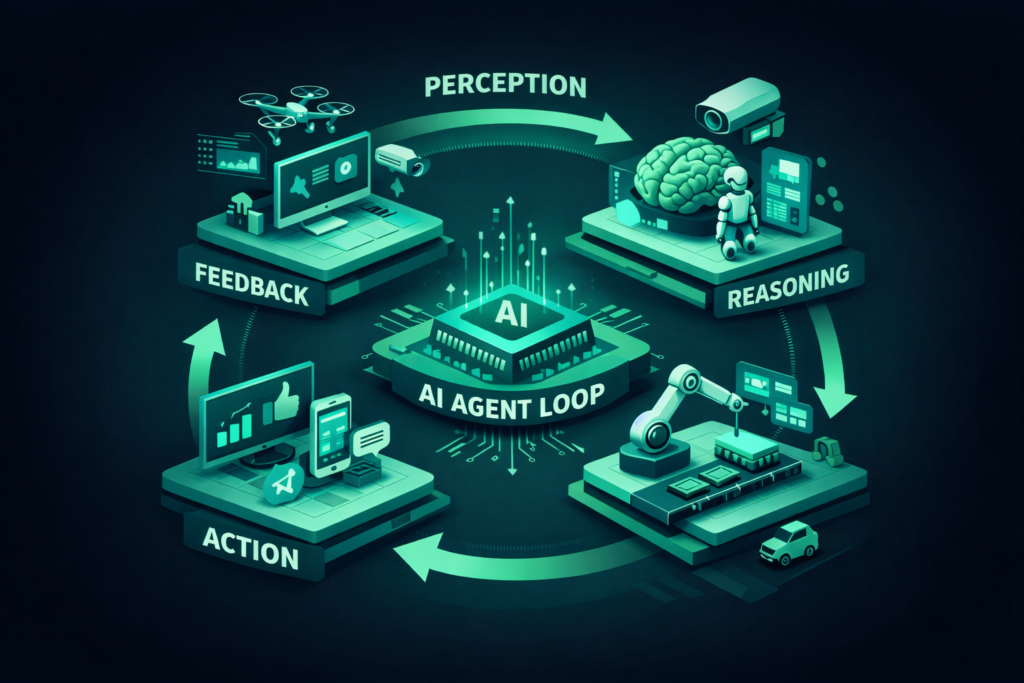
This “perceive → decide → act → observe” loop runs continuously until the goal is reached or it hits an error it can’t resolve. That loop is what makes agents fundamentally different from chatbots.
7 Types of AI Agents You Need to Know
Not all AI agents are the same. The type of agent you need depends entirely on what problem you’re solving.
Here’s every category that matters in 2026, with a plain-English explanation of each.
| Agent Type | How It Works | Best For | Example Tools |
|---|---|---|---|
| Simple Reflex Agent | Responds to current input using predefined rules. No memory. | FAQ bots, basic automation triggers | Zapier, basic chatbots |
| Model-Based Agent | Maintains an internal world model to make better decisions | Customer support with context | Intercom AI, Zendesk AI |
| Goal-Based Agent Popular | Works backward from a defined goal to plan its actions | Research, project management, outreach | AutoGPT, BabyAGI, CrewAI |
| Utility-Based Agent | Weighs multiple outcomes and picks the highest-value action | Trading, resource allocation, logistics | Custom LangChain builds |
| Learning Agent | Improves over time through feedback and reinforcement | Recommendation systems, adaptive workflows | OpenAI Assistants API, fine-tuned models |
| Multi-Agent System 2026 Trend | Multiple agents work together, each specialised in one role | Complex workflows: dev + QA + docs agents working in parallel | CrewAI, Microsoft AutoGen, LangGraph |
| Agentic AI System | An agent with persistent memory, planning capability, and human-in-the-loop oversight | Enterprise deployments, long-running tasks | Salesforce Agentforce, Google Vertex AI Agents |
For a deeper look at the distinction between a regular AI agent and agentic AI, see: What Is Agentic AI?
Best AI Agent Tools in 2026 (Full Comparison)
I’ve tested all of these. Here’s the honest breakdown – no rankings paid for, no affiliate bias in the ratings.
| Tool | Best For | Coding Required? | Free Plan? | Starting Price | Rating |
|---|---|---|---|---|---|
| n8n Top Pick | Automation + AI workflows, self-hostable | No (visual) | Yes | $20/mo cloud | 9.2/10 |
| CrewAI | Multi-agent systems, developer projects | Python required | Yes (open source) | Free / Enterprise | 9.0/10 |
| Microsoft AutoGen | Enterprise multi-agent, Microsoft stack | Python required | Yes (open source) | Free / Azure costs | 8.7/10 |
| LangChain | Custom agent pipelines, developer flexibility | Python / JS required | Yes | Free / Usage-based | 8.5/10 |
| Voiceflow | Voice + chat agents, non-technical teams | No | Yes | $50/mo | 8.3/10 |
| Botpress | Customer support agents, no-code | No | Yes | $89/mo | 8.2/10 |
| OpenAI Assistants API | Building custom GPT-powered agents | API knowledge needed | No (usage-based) | $0.02/1K tokens+ | 8.8/10 |
| Make (Integromat) | Workflow automation with AI steps | No | Yes | $9/mo | 8.0/10 |
Bottom Line
n8n is my top pick for 2026 if you want power without being locked into a vendor. CrewAI is the best choice if you’re comfortable with Python and want to build multi-agent systems. If you’re a complete beginner, start with Voiceflow or Botpress — you’ll build something functional in under 2 hours.
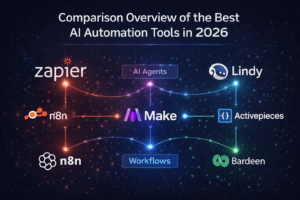
For a full head-to-head breakdown of the automation platforms, read: n8n vs Zapier vs Make (2026)
Real-World Use Cases: What People Are Building With AI Agents
Here’s the thing: most “AI agent use case” articles list theoretical applications. I want to show you what’s actually being built and what results are coming out.
1. AI Sales Development Agent
Companies are deploying agents that scan LinkedIn, identify warm leads, research each company, write personalised outreach emails, and schedule follow-ups — autonomously. Relevance AI reports that their customers reduced SDR time spent on research by 74% using this approach.
2. AI Coding Agent
Cursor and GitHub Copilot moved from “autocomplete” to full agent mode in 2025. Agents now read your codebase, identify bugs, propose fixes, run tests, and open pull requests. Companies like Stripe and Figma report 40–60% faster feature development cycles.
3. AI Customer Support Agent
Klarna’s AI agent replaced the work of 700 customer service agents in its first month (2024), handling 2.3 million conversations. In 2026, similar deployments are standard across fintech, SaaS, and e-commerce. Resolution rates are 85–92% for Tier-1 queries.
4. AI Research Agent
Consulting firms are using multi-agent systems where one agent searches the web, one reads PDFs, one analyses data, and one synthesises the output. What took a junior analyst 3 days now takes 40 minutes.
5. AI Content Operations Agent
Media companies (and growing publications like this one) use agents to monitor trending topics, pull stats, draft article outlines, and flag SEO opportunities — daily. The human editor reviews and publishes. Output triples without tripling the team.
How to Build an AI Agent Without Coding (Step-by-Step)
I’m going to walk you through building a real agent — one that monitors a subreddit, finds posts where people ask for tool recommendations, and drafts a reply with your recommendation. No code required. I’ll use n8n.
- Sign up for n8n
Go to n8n.io and create a free account. You’ll get access to the visual workflow builder. No credit card required.
2. Create a new workflow and add a trigger
Click “New Workflow.” Add a Schedule Trigger node — set it to run every 6 hours. This is when your agent wakes up and checks for new posts.
3. Add an HTTP Request node to pull Reddit posts
Use Reddit’s JSON API endpoint: https://www.reddit.com/r/[subreddit]/new.json. Set the node to GET this URL. You’ll get a list of the latest posts in JSON format.
4. Add an AI node to filter relevant posts
Add an OpenAI node. Pass each post title and body to Claude or GPT-4o with this prompt: “Does this post ask for a tool recommendation? Reply YES or NO only.” Filter for YES responses.
5. Add a second AI node to draft a reply
For posts that pass the filter, use a second AI node to draft a reply recommending your tool. Give your product’s key features in the system prompt. Set the tone to “helpful, not salesy.”
6. Send yourself a notification
Add a Gmail or Telegram node to send you the drafted reply + original post link for review. You review, edit if needed, and post manually. Human-in-the-loop, agent handles the grind.
7. Test and activate
Click “Test workflow” to see a live run. Fix any broken nodes. Then activate the workflow — it’ll run on schedule from here. You just built a functioning AI agent.
For more n8n workflows like this, see: What Is n8n?
7 Mistakes to Avoid When Building AI Agents
I’ve made all of these. Learn from my broken workflows.
Mistake 1: Giving the agent too many tools at once. More tools = more confusion. Start with 2–3 tools and add more only when needed. An agent that can “do anything” often does nothing well.
Mistake 2: No human-in-the-loop for critical actions. Don’t let your agent send emails, post publicly, or make payments without a review step. Add an approval node before any irreversible action.
Mistake 3: Vague goals. “Grow my business” is not an agent-compatible goal. “Find 20 SaaS companies in fintech with under 50 employees, extract the founder’s name and LinkedIn URL, and add to this Google Sheet.” Be specific.
Mistake 4: Ignoring memory limits. Most LLM models have context windows of 128K–1M tokens, but agent workflows that run for hours will still exceed them. Plan for long-term memory storage (a database, vector store, or external notes system).
Mistake 5: Not testing edge cases. What happens if an API goes down? If a web page can’t be scraped? If the AI returns “I don’t know”? Build fallback logic for each tool call.
Mistake 6: Over-automating immediately. Start with a workflow where the agent does 80% and a human reviews the final 20%. Only remove the human step after you’ve validated the output quality over 50+ runs.
Mistake 7: Choosing the wrong model. Claude 3.7 Sonnet is better for complex reasoning and long documents. GPT-4o is faster for quick tasks. Gemini 2.5 Pro handles very long contexts well. Match the model to the task, not to brand loyalty.
AI Agent vs Chatbot vs Agentic AI: The Exact Differences
These three terms are used interchangeably online. They mean very different things.
| Feature | Chatbot | AI Agent | Agentic AI System |
|---|---|---|---|
| Responds to input | ✓ | ✓ | ✓ |
| Executes multi-step tasks | ✗ | ✓ | ✓ |
| Uses external tools | Limited | ✓ | ✓ |
| Persistent long-term memory | ✗ | Partial | ✓ |
| Plans ahead autonomously | ✗ | Basic | Advanced |
| Works alongside other agents | ✗ | Some | ✓ (native) |
| Enterprise-grade oversight | ✗ | ✗ | ✓ |
For the full breakdown with examples, read: What Is an AI Agent? and What Is Agentic AI?
Top AI Agent Frameworks for Developers (2026)
If you’re technical and want to build custom agents from scratch, these are the frameworks that matter.
LangChain
The most widely used agent framework. Over 85,000 GitHub stars. Works with any LLM and supports a massive library of pre-built tools. Best for: flexible, custom agent pipelines. Downside: can be over-engineered for simple tasks.
LangGraph
LangChain’s newer framework is specifically for stateful, graph-based multi-agent workflows. Better for complex orchestration where agents need to hand off to each other. Think of it as LangChain’s more structured sibling.
CrewAI
The cleanest multi-agent framework I’ve used. You define “crews” of agents, each with a role, goal, and backstory. They collaborate on a shared task. The syntax is simple enough that a technical non-developer could use it after a weekend of learning.
Microsoft AutoGen
Microsoft’s open-source framework is deeply integrated with Azure. Best for enterprise teams already on the Microsoft stack. Supports “conversational agents” that talk to each other to solve problems.
OpenAI Assistants API
The simplest way to add agent-like behaviour to a GPT-4-based app. Supports function calling, file retrieval, and code interpretation out of the box. Best for: building on top of ChatGPT’s infrastructure without a custom framework setup.
How Much Does It Cost to Build an AI Agent in 2026?
Let me give you honest numbers, not marketing ranges.
| Agent Type | Build Cost | Monthly Running Cost | Who This Is For |
|---|---|---|---|
| Simple no-code agent (n8n / Make) | $0–$50 (setup time) | $20–$100/mo platform + API costs | Solopreneurs, small teams |
| Mid-complexity agent (Voiceflow / Botpress) | $200–$2,000 (if hired out) | $89–$300/mo | SMBs, startups |
| Custom Python agent (LangChain / CrewAI) | $2,000–$15,000 dev time | $100–$1,000/mo API + infra | Tech startups, agencies |
| Enterprise agent system (AutoGen / Vertex) | $50,000–$500,000+ | $5,000–$50,000+/mo | Large enterprises |
Here’s what nobody tells you about agent costs: the LLM API is usually the biggest variable expense. If your agent runs 500 tasks/day using GPT-4o at $5 per 1M tokens, a 2,000-token task costs $0.01 — or $5/day, $150/month. That scales fast. Monitor your token usage from day one.
The Future of AI Agents: What’s Coming in 2026–2027
Three trends that will define AI agents over the next 18 months:
1. Agent-to-agent communication becomes standard. The MCP protocol is already allowing agents to talk to each other through standardised APIs. By 2027, most enterprise workflows will involve dozens of specialised agents handing tasks to each other without human coordination.
2. Physical agents emerge from labs. Boston Dynamics, Figure AI, and 1X are combining LLM reasoning with physical robot bodies. Warehouse agents that can physically move, sort, and reason about their environment are already in limited commercial deployment as of 2026.
3. Personal agents become default. Apple, Google, and Microsoft are all building agent layers into their operating systems. By the end of 2026, having an AI agent manage your calendar, email, files, and purchases will be a default OS feature — not a third-party addon.
If you want to understand where the underlying technology is going, read: What Is MCP?
My Take: Why AI Agents Are the Biggest Shift Since the Smartphone
I’ll be direct: I think most people are significantly underestimating what’s happening with AI agents.
The smartphone didn’t replace everything at once. It replaced one thing — the need to carry a camera, a map, a music player, a phone, a computer. One device that quietly ate multiple industries. AI agents are doing the same thing to digital labour.
But here’s where I push back on the panic: the agents that work today are narrow. They’re good at repeatable, clearly defined tasks. They break on ambiguity. They fail when the goal shifts mid-task. A good human employee handles edge cases automatically. A well-trained agent still needs those edges mapped out explicitly.
What I think this means practically:
If you’re a knowledge worker, your job isn’t disappearing. Your value shifts from doing the task to defining the task precisely enough for an agent to execute it. That’s a different skill — and one most people haven’t developed yet.
The people winning in 2026 aren’t the ones who built AI agents. They’re the ones who got good at thinking in structured goals and clear tool definitions — the language agents understand.
Learn that, and you become the human who makes agents 10x more useful. Ignore it, and you’re being out-competed by someone who did.
People Also Ask
What is the difference between an AI agent and ChatGPT?
ChatGPT is a conversational AI model — you ask a question, it answers. An AI agent uses a model like ChatGPT as its reasoning engine but adds memory, tools, and an autonomous action loop. An agent keeps working through a multi-step task without you managing each step.
Can I build an AI agent without coding?
Yes. Platforms like n8n, Voiceflow, Botpress, and Make let you build AI agents visually with no code. n8n is the most powerful free option. You can have a basic working agent running in under 2 hours with no programming background.
Are AI agents safe to use?
AI agents are safe when designed with human-in-the-loop steps before irreversible actions like sending emails or making payments. Never give an agent access to financial accounts or critical systems without review checkpoints. Start with read-only workflows to build trust gradually.
What is the best AI agent tool in 2026?
For no-code users: n8n is the best all-around choice with a generous free tier. For developers: CrewAI or LangChain, depending on whether you need multi-agent or single-agent workflows. For enterprises: Microsoft AutoGen or Salesforce Agentforce.
How much does an AI agent cost?
A simple no-code agent costs $0–$100/month to run (platform + API usage). Custom-built agents run $2,000–$15,000 in development plus $100–$1,000/month ongoing. Enterprise systems can cost $50,000+ to build. The highest variable cost is LLM API usage.
Frequently Asked Questions
What programming language is used to build AI agents?
Python is the dominant language for AI agent development, used in LangChain, CrewAI, and AutoGen. JavaScript/TypeScript is used for browser-based agents. No-code tools like n8n and Voiceflow require no programming language at all.
What is a multi-agent system?
A multi-agent system is a collection of AI agents working together, each specialised in a specific role. For example, a “researcher” agent, a “writer” agent, and an “editor” agent might collaborate on producing a report. Each agent handles its domain; a coordinator manages handoffs between them.
Can AI agents make mistakes?
Yes. AI agents can hallucinate (invent facts), misinterpret goals, fail when tools break, or get stuck in repetitive loops. This is why human review steps are essential for high-stakes workflows. Agents work best for tasks where errors are recoverable, and quality can be verified.
What is the difference between an AI agent and a bot?
A traditional bot follows a fixed script – if X happens, do Y. An AI agent uses an LLM to reason about what to do, adapts to unexpected inputs, and can handle tasks it wasn’t explicitly programmed for. Bots are deterministic; agents are adaptive.
Do AI agents need an internet connection to work?
Most AI agents require an internet connection to access LLM APIs (OpenAI, Anthropic, Google). Some frameworks support locally run open-source models (Llama 3, Mistral) that work offline, but these typically have less capability than cloud-based models.
What is agent memory in AI?
Agent memory refers to how an AI agent stores and retrieves information. Short-term memory is the current context window (what the agent remembers during one session). Long-term memory uses external databases or vector stores to persist information across sessions. Both are needed for complex, ongoing tasks.
Is n8n better than Zapier for AI agents?
For AI-native workflows, n8n has a stronger advantage: it’s self-hostable, has more flexible AI nodes, supports LangChain integration, and has a more generous free tier. Zapier is easier to start with but less powerful for complex, looping AI tasks. Full comparison: n8n vs Zapier vs Make.
What is the ReAct framework for AI agents?
ReAct (Reasoning + Acting) is an agent architecture that alternates between reasoning steps (“I need to find X”) and action steps (“I’ll search the web for X”). It’s a foundational design pattern used by LangChain, AutoGPT, and most modern agent frameworks. It makes agent decision-making more transparent and easier to debug.
Can AI agents replace human workers?
For highly repetitive, clearly defined tasks – yes, partially. For roles requiring judgement, empathy, creativity, and handling novel situations – not in 2026. McKinsey’s 2025 data shows 68% of enterprise agent deployments expanded or redirected headcount rather than eliminating it. Agents augment workers more than they replace them currently.
What is vibe coding, and how does it relate to AI agents?
Vibe coding is the practice of building software by describing what you want in natural language to an AI model, rather than writing code manually. AI coding agents are the infrastructure that powers vibe coding – they read your codebase, generate code, run tests, and iterate. See our guide: What Is Vibe Coding?
⚡ Key Takeaways
- An AI agent perceives its environment, reasons through a goal, takes actions using tools, and loops until done — without constant human input.
- The market is growing from $7.84B in 2026 to a projected $47.1B by 2030 — driven by enterprise adoption and no-code accessibility.
- You don’t need to code to build a working AI agent. n8n, Voiceflow, and Botpress make it accessible to anyone.
- The biggest mistakes are giving agents too many tools, skipping human review steps, and setting vague goals.
- The real skill in 2026 isn’t building agents — it’s defining goals precisely enough for an agent to execute them. That’s the human advantage.
Continue Reading
AI Agents: What Is an AI Agent? Plain-English Definition (2026)
Agentic AI: What Is Agentic AI? How It Differs From Regular AI Agents
Automation: n8n vs Zapier vs Make: Which Automation Tool Wins in 2026?
MCP: What Is MCP? The Protocol Connecting AI Agents to Everything
n8n: What Is n8n? The Open-Source Automation Tool Explained
Vibe Coding: What Is Vibe Coding? Build Apps Without Writing Code
Sources & References
- MarketsandMarkets — AI Agents Market Report 2026 — Global market size and CAGR data
- Grand View Research — AI Market Size Forecast to 2030 — $47.1B projection
- McKinsey & Company — The State of AI 2025 — Enterprise adoption data
- Salesforce — State of AI Report 2025 — 3–6 hours/week time saved statistic
- Anthropic — Introducing the Model Context Protocol (MCP) — November 2024
- Klarna — Klarna AI Assistant Press Release — 700 agent equivalent workload
- Russell, S. & Norvig, P. — Artificial Intelligence: A Modern Approach (4th Ed.) — Foundational agent taxonomy

Leave a Reply