

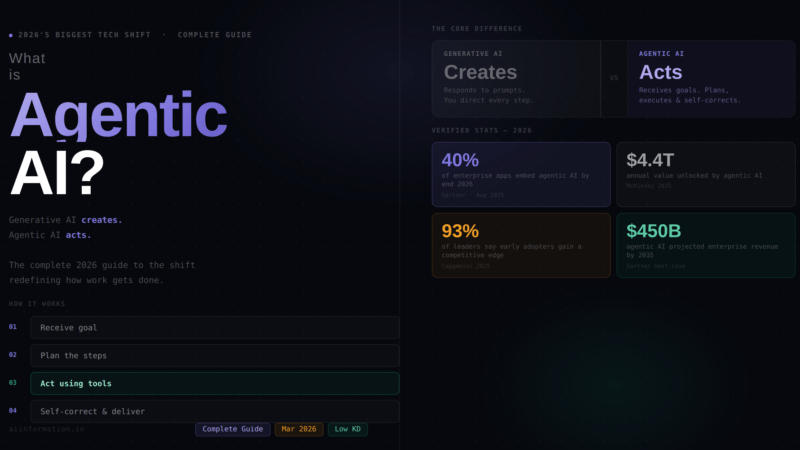
Quick Answer – What Is Agentic AI? Agentic AI is artificial intelligence that can set goals, make plans, take action, and complete multi-step tasks on its own – without you directing every step.
Unlike generative AI (which generates content when asked), agentic AI acts. It browses the web, sends emails, writes code, books appointments, fixes its own mistakes, and delivers a finished result.
The one-line version that makes it stick: “If AI is the brain, and generative AI is the voice, then agentic AI is the hands.”
By end of 2026, 40% of enterprise applications will embed agentic AI — up from less than 5% in 2025. That is an 8x jump in 12 months. (Source: Gartner, August 2025)
Table of Contents
The Shift Nobody Explains Clearly Enough
There is a moment in the history of every major technology when it stops being something experts talk about and starts being something everyone uses without thinking about it. Email felt overwhelming in 1995. Google felt magical in 2000. Smartphones felt optional in 2008. None of those things feel like technology anymore. They just feel like life.
Agentic AI is at that exact inflection point in 2026. Except this one is moving faster than any of the others did.
A marketing agency recently described their Monday morning routine. Before they arrived at the office, their agentic AI system had already reviewed last week’s campaign performance, identified three underperforming ad sets, drafted revised copy for each, scheduled A/B tests, updated the project board, and sent a summary to the client – all before 9am. The human team came in to creative decisions, relationships, and strategy. The administrative and analytical work was already done.
That is not a futuristic demo. That is available right now, to anyone willing to set it up. And most people still do not have a clear picture of what agentic AI actually is.
This guide fixes that. No jargon. No hype. Just a clear, deeply researched explanation of what agentic AI is, what it can do, and how to start using it today for free.
What Is Agentic AI – The Real Explanation
The word “agentic” comes from “agency” – the ability to act independently, to make decisions without someone directing every move.
Agentic AI, then, is AI with genuine agency. AI that does not wait to be asked. AI that can be handed a goal — not a prompt, not a question, but an actual goal — and figure out how to achieve it.
IBM defines it as: “AI systems designed to operate autonomously with goal-directed behaviour, capable of planning, making decisions, using tools, and executing multi-step tasks with minimal human supervision.”
But here is the clearest plain-language version: when you use standard ChatGPT, you are the driver. You ask, it responds, you decide what to do, you ask again. Every step requires you. The AI is entirely reactive.
Agentic AI flips this. You give it a destination — a goal — and it figures out the route, drives itself there, handles the obstacles, and arrives with the result. You are no longer the driver. You are the person who decides where to go.
That shift from reacting to acting is what makes agentic AI the defining technology of 2026.
Generative AI vs Agentic AI: The Difference That Changes Everything
This is the most-searched comparison right now, and most explanations get it wrong by being too abstract. Here is the concrete version.
| Comparison | Generative AI | Agentic AI |
|---|---|---|
| Core function | Creates content on request | Completes goals autonomously |
| What you give it | A prompt or question | An objective or goal |
| What you get back | Text, image, code, or data | A completed task or outcome |
| Human input needed | Every single step | Mainly at the start |
| Can use tools? | Limited | Yes — web, email, apps, files, APIs |
| Memory | Within one session only | Persists across tasks over time |
| Self-correction | Cannot fix its own failures | Detects errors and retries differently |
| Nature | Reactive — waits for prompts | Proactive — pursues goals |
| Best analogy | A creative assistant | A capable team member |
The “Work Gap” explained: Generative AI is incredible but creates a Work Gap. If it writes a report, a human still has to fact-check it, format it, email it, follow up on responses, and update records. Agentic AI closes the Work Gap. It produces outcomes, not just drafts. That is why Salesforce, IBM, and Red Hat all describe it the same way: generative AI creates output; agentic AI creates results.
A real example that makes this impossible to miss:
You tell generative AI: “Write a follow-up email for a sales meeting.” It writes one. You still have to address it, personalise it, send it, track it, and follow up again. That is still entirely your job.
You tell agentic AI: “Handle follow-ups for all sales meetings from this week.” It finds the meetings in your calendar, reads your notes from each, writes personalised emails based on what was discussed, checks the CRM history for each contact, sends at the optimal time per recipient, tracks opens and replies, flags non-responders, and updates the CRM. You review the summary on Friday.
Same starting point. Entirely different amount of human effort. That gap is why McKinsey estimates agentic AI could unlock $2.6–$4.4 trillion in annual economic value.
How Agentic AI Actually Works (5 Plain-English Steps)
You do not need to understand the architecture. But knowing how it works makes you dramatically better at using it.
Step 1 – Receive a Goal
Unlike a chatbot that processes a single prompt, agentic AI receives an objective. “Research the competitive landscape for our product.” “Manage my email inbox this week.” “Find and qualify 20 sales leads in the healthcare sector.” The goal sets everything that follows.
Step 2 – Plan the Steps
The system breaks the goal into a sequence of concrete actions. For simple goals, the plan is short. For complex goals, it builds a genuine multi-step plan: what information to gather, which tools to use at each step, what success looks like, and in what order things need to happen. IBM calls this “task decomposition” — it is the step that makes the agent genuinely autonomous rather than just fast.
Step 3 – Act Using Tools
It executes: web search, email, calendar, files, code execution, databases, APIs, external applications. The combination of available tools determines what the agent can accomplish. As Salesforce puts it: “AI agents require access to tools such as CRMs, ticketing systems, knowledge bases, and email platforms to translate intelligence into action.”
Step 4 — Monitor and Self-Correct
When something fails — a website is down, an API returns an error, a result is unexpected — it does not stop. It reassesses, tries an alternative, and continues. This is the step that separates agentic AI from basic automation scripts. Automation follows rules. Agentic AI makes decisions.
Step 5 – Deliver and Report
The agent delivers the result — completed task, updated database, set of sent emails, deployed code — and flags the things it could not handle autonomously so you can review only the exceptions.
The most important practical insight: goal quality determines output quality. “Help me grow my business” gives the agent nothing to work with. “Identify our top 10 competitors, compare their pricing pages, and produce a 500-word summary table” gives it something specific to plan, execute, and deliver. Learning to write clear goals is the skill that will matter most over the next few years.
Real Examples Working Right Now in 2026
Amazon Q Developer – Code Modernisation at Scale
Amazon used its own agentic system to modernise thousands of legacy Java applications. The work would have taken a large engineering team years. The multi-agent system analysed existing code, planned the modernisation approach for each application, executed changes, tested results, and flagged edge cases for human review — in a fraction of the original timeline.
AtlantiCare Healthcare – 66 Minutes Back Per Doctor Per Day
AtlantiCare, a US healthcare network, deployed an agentic clinical documentation assistant. Among the 50 physicians tested, it achieved an 80% adoption rate and a 42% reduction in documentation time — saving approximately 66 minutes per doctor per day. That time went back to direct patient care.
JP Morgan COiN – Legal Document Review
Their Contract Intelligence agent reviews legal agreements and extracts key clauses in seconds. The same work previously required tens of thousands of attorney hours per year. The attorneys now focus on judgment, negotiation, and clients.
Salesforce Agentforce – Customer Service Resolution
Deployed across enterprise accounts, it handles resolution autonomously for standard customer service cases, escalates complex issues with full context already prepared, and follows up automatically on unresolved tickets. Gartner predicts agentic AI will autonomously resolve 80% of common customer service issues by 2029.
Small Business: n8n Workflow Automation
At the individual scale, thousands of small businesses use open-source n8n to build their own agentic workflows without enterprise budgets. A content agency connects email, project management, social media, and analytics through an agentic workflow that reads briefs, creates tasks, drafts content, schedules posts, monitors performance, and compiles weekly reports — all automatically.
What Agentic AI Is Doing Across Every Industry
Customer Service
- Resolving standard queries end-to-end without human involvement
- Routing complex issues to humans with full context already summarised
- Contact centres using autonomous agents will reduce cost-per-contact by 20–40% by 2026 (Second Talent Research)
- By 2029: 80% of common customer service issues resolved autonomously without human intervention (Gartner)
Marketing and Sales
- Running complete lead qualification: identify, research, score, personalise outreach
- Managing email sequences adjusted based on engagement signals
- By 2028: 60% of brands will use agentic AI for personalised one-to-one interactions (Gartner, January 2026)
- By 2028: 90% of B2B buying will be AI agent-intermediated, pushing over $15 trillion through AI agent exchanges (Gartner)
Software Development
- Writing new features across multiple files with full codebase awareness
- Detecting bugs and applying fixes autonomously
- Walmart: 4 million developer hours saved through AI coding agent deployment
- By 2026: roughly 40% of enterprise software built using natural-language-driven agentic approaches
Healthcare
- Reducing physician documentation burden by 42% (AtlantiCare, 2025)
- Matching patients to clinical trials based on full medical profiles
- Medical AI agents now score over 91% on medical licensing examinations (Second Talent Research)
Finance
- Evaluating up to 5,000 transaction data points per millisecond for fraud detection
- Financial services AI investment projected to reach $97 billion by 2027 (World Economic Forum)
Best Free Agentic AI Tools to Try Today
| Tool | Best for | Free tier? | What it does agentically |
|---|---|---|---|
| Microsoft Copilot | Office workers, beginners | Yes — no account needed | Multi-step research, email drafting, meeting summaries, task management |
| ChatGPT (free) | General tasks | Yes | Web search, file reading, code execution, multi-step planning |
| Perplexity | Research | Yes | Multi-source research with live citations; structured reports |
| n8n | Custom workflows | Yes (self-hosted) | Connects AI to 400+ apps; build custom agentic workflows |
| Zapier AI | Business automation | Limited free tier | Multi-step workflows connecting apps with AI decision-making |
| Lindy | Professionals, SMEs | 40 tasks/month free | Email triage, scheduling, CRM updates in your writing style |
| Claude Code | Developers | No (paid) | Reads codebases, writes across files, debugs autonomously |
Start here: Go to copilot.microsoft.com right now. No account required. Type a multi-step goal and watch it plan and execute. That is agentic AI in action, free, in two minutes.
Verified Stats – Not Marketing Numbers
These come exclusively from independent research firms. Every source is named so you can verify yourself.
| Metric | Number | Source |
|---|---|---|
| Enterprise apps with agentic AI by end 2026 | 40% | Gartner, August 2025 |
| Same figure in 2025 | <5% | Gartner, August 2025 |
| AI agent market size in 2025 | $7.6–7.8 billion | Grand View Research |
| Projected market size by 2030 | $52+ billion | Grand View Research |
| Market CAGR 2025–2030 | 46.3% per year | Grand View Research |
| Annual value agentic AI could unlock | $2.6–$4.4 trillion | McKinsey State of AI 2025 |
| Agentic AI revenue potential by 2035 | $450 billion (30% of enterprise software) | Gartner best-case |
| Daily work decisions made by agentic AI by 2028 | 15% | Gartner |
| Brands using agentic AI for personalisation by 2028 | 60% | Gartner, January 2026 |
| B2B buying AI agent-intermediated by 2028 | 90% | Gartner |
| Leaders who believe early adopters gain competitive edge | 93% | Capgemini Rise of Agentic AI |
| Agentic AI projects at risk of cancellation by 2027 | Over 40% | Gartner (governance warning) |
| Multi-agent system inquiries surge Q1 2024–Q2 2025 | 1,445% | Gartner |
| Organisations successfully scaled agents to production | Fewer than 1 in 4 | McKinsey |
| Enterprise shadow agent usage (unsanctioned) | 50%+ of AI usage | Second Talent Research |
That last Gartner figure on project cancellations deserves attention. More than 40% of agentic AI projects will fail by 2027 — not because the technology does not work, but because of poor governance and vague goal-setting. Deloitte identified a key pattern among failing organisations: they attempt to automate current processes rather than reimagine workflows for an agentic environment. Also worth noting: Deloitte coined the term “agent washing” to describe vendors rebranding existing automation as “agentic AI” — industry analysts estimate only around 130 of thousands of claimed AI agent vendors are building genuinely agentic systems.
Will Agentic AI Take Your Job? The Honest Answer
This is the question underneath every conversation about agentic AI, and it deserves an honest answer.
The evidence consistently points in one direction: agentic AI is replacing specific tasks within jobs, not jobs themselves — at least in the near term. And in most documented cases, it is the administrative, repetitive, and high-volume tasks that get automated, while judgment-based, relationship-based, and creative tasks remain with humans.
The physicians at AtlantiCare did not lose their jobs when the AI agent took over documentation. They got 66 minutes a day back to spend with patients. The attorneys at JP Morgan did not lose their jobs when the AI agent started reviewing contracts. They stopped doing something tedious and started doing more of what they find valuable.
However, Gartner’s 2026 strategic predictions contain a warning: by 2026, 50% of global organisations will require “AI-free” skills assessments for employees — because the atrophy of critical thinking skills from over-reliance on AI is becoming a real organisational risk.
By 2029, Gartner predicts that at least half of all knowledge workers will be expected to create, manage, and deploy AI agents as a standard part of their role. Building an agent will be as normal as building a spreadsheet today.
The honest summary: agentic AI will change almost every job over the next five years. The people adapting fastest — who learn to define goals well, evaluate AI outputs critically, and focus on what AI cannot do — will find their value increases. The people who ignore the shift will find it increasingly difficult to compete.
The Risks Nobody Mentions Honestly
Risk 1 – Shadow Agents (The Biggest One Nobody Talks About)
Unsanctioned agentic AI deployed by employees without IT approval now accounts for over 50% of enterprise AI usage (Second Talent Research). These shadow agents often lack proper privacy controls, accidentally sending sensitive corporate data to public AI models. Most organisations do not know this is happening.
Risk 2 – Agent Washing
Deloitte coined this term for vendors rebranding existing automation tools as “agentic AI.” Industry analysts estimate only around 130 of thousands of claimed AI agent vendors are building genuinely agentic systems. Before buying or subscribing, ask exactly what the tool does autonomously and what still requires human input at every step.
Risk 3 – Prompt Injection
Malicious instructions embedded in content the agent reads — a website, email, or document — can hijack its actions. Gartner predicts that by 2028, 25% of enterprise security breaches will be attributable to AI agent abuse. This is already happening.
Risk 4 – The 40% Failure Rate
Gartner’s warning: more than 40% of agentic AI projects will be cancelled by end of 2027 due to escalating costs, unclear ROI, and inadequate risk controls. The cause is almost always the same: vague goals applied to poorly designed workflows.
Risk 5 – Workslop
Deloitte introduced this term for a real phenomenon: poorly designed agentic applications can actually add work to a process rather than reduce it. When agents are applied to the wrong tasks, or when their outputs require extensive human correction, teams end up doing more work, not less.
Risk 6 – Legal Liability Gap
By end of 2026, Gartner predicts “death by AI” legal claims will exceed 2,000 due to insufficient AI risk guardrails — cases where autonomous AI decisions in medical, financial, or infrastructure contexts cause real harm. Legal frameworks are scrambling to catch up with deployment speed.
15 Questions People Are Actually Searching Right Now
These are real questions from Google People Also Ask, Reddit, Quora, and DataCamp’s interview research – with honest, direct answers.
1. Is ChatGPT an agentic AI?
Standard ChatGPT is primarily generative AI — it responds to prompts. However, ChatGPT’s newer features like web browsing, code execution, and Operator mode give it primitive agentic capabilities. As Coursera explains, these popular chatbot platforms “automatically initiate a web search, parse data, and return it as part of conversation — a primitive form of agentic AI.” Full agentic ChatGPT means the paid Operator mode, which can navigate websites, fill forms, and complete multi-step tasks autonomously.
2. What is the difference between an AI agent and agentic AI?
An AI agent is a single system — one software entity that can perceive, plan, and act. Agentic AI is the broader concept and field — it describes AI systems that have agency. All AI agents are agentic AI, but agentic AI includes multi-agent systems where multiple agents work together, as well as the frameworks and protocols that make agents possible. Think of it like: an AI agent is a single employee; agentic AI is the concept of the entire autonomous workforce.
3. Is agentic AI the same as automation?
No – this is one of the most common misconceptions. Traditional automation follows fixed rules: if X happens, do Y. It cannot handle situations its creator did not explicitly program for. Agentic AI makes decisions. It can handle unexpected situations, choose between multiple approaches, correct its own mistakes, and adapt when circumstances change. Automation is a script. Agentic AI is a system that can think through a problem it has never seen before. Deloitte specifically warns about “agent washing” — vendors calling basic automation tools “agentic” when they are not.
4. Can agentic AI make mistakes?
Yes – and they can be consequential. Because agentic AI acts autonomously, its mistakes are not just wrong answers on a screen. They can be emails sent to the wrong people, files deleted, incorrect data entered into systems, or purchases made. The risks scale with the permissions the agent has. The practical approach: start with low-stakes tasks, require human approval for irreversible actions, and review outputs regularly until you have established confidence in how a specific agent behaves on specific task types.
5. What is “agent washing”?
Agent washing is Deloitte’s term for vendors rebranding existing automation capabilities as “agentic AI.” Because “agentic AI” is the hot phrase of 2026, many companies are adding it to their marketing without meaningfully changing their products. Industry analysts estimate only around 130 of the thousands of companies claiming to offer AI agents are building genuinely agentic systems. How to spot it: ask whether the system can handle tasks it was not explicitly programmed for, whether it can self-correct when something unexpected happens, and whether it genuinely plans steps rather than following a fixed script.
6. Does agentic AI need the internet to work?
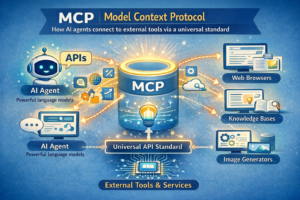
Not necessarily, but it is significantly more powerful with connectivity. An agent operating only on local files can still plan, execute, and correct within its available environment. Most valuable agentic use cases – web research, email management, booking, CRM updates — require connectivity to external systems. As Red Hat explains: “Agentic AI has limited functionality unless connected with external systems, APIs, and real-time data sources.” The Model Context Protocol (MCP) has become the standard method for connecting agents to external tools in 2026.
7. What is MCP and why does it matter for agentic AI?
MCP – Model Context Protocol – is the standardised “plug” that connects AI agents to external tools and systems. Think of it as the USB standard for AI: instead of every AI tool needing a custom integration with every other app, MCP provides a universal connector. Anthropic created it, Sam Altman endorsed it, and it has now become the industry standard for connecting agents to calendars, email, CRMs, file systems, and hundreds of other applications. Without MCP, an agent can plan – but it cannot actually do anything outside its own environment.
8. Can small businesses use agentic AI without a big budget?
Yes – and this is one of the most underreported stories of 2026. Microsoft Copilot (free), ChatGPT free tier, Perplexity (free), and n8n (free self-hosted) all provide genuine agentic capability at no cost. Lindy offers 40 agent tasks per month free. A small business owner can automate email triage, lead research, social media scheduling, and weekly reporting without spending anything. The tools that existed two years ago at enterprise-only prices are now available to anyone. Gartner predicts organisations that design for people to work alongside AI will get the best outcomes regardless of company size.
9. How is agentic AI different from a virtual assistant like Siri or Alexa?
Siri and Alexa are reactive voice interfaces. They listen for a command, execute one specific action (play a song, set a timer, answer a question), and stop. They have no ability to plan multi-step tasks, no persistent memory of what they did yesterday, and no capacity to adapt if something goes wrong. Agentic AI can pursue goals across multiple steps over extended periods, use dozens of tools, correct its own failures, and maintain context across sessions. The comparison is roughly like comparing a light switch to a building management system: both control something electrical, but one just turns on and off while the other monitors, adjusts, and optimises continuously.
10. What is a multi-agent system?
A multi-agent system is multiple specialised AI agents working together as a coordinated team. Instead of one agent doing everything, you have: a research agent that gathers information, a writing agent that produces drafts, a review agent that checks for errors, and a publishing agent that handles distribution. They share context, hand tasks to each other, and complete complex workflows end-to-end. Gartner reported a 1,445% surge in multi-agent system inquiries from Q1 2024 to Q2 2025, calling it the architecture shift that defines enterprise AI in 2026. By 2027, one-third of all agentic implementations will use multi-agent systems.
11. Is it safe to give an agentic AI access to my email or files?
It depends on the platform and the use case. For reputable platforms like Microsoft Copilot or Lindy, with clear privacy policies and established security practices, yes — millions of people do this daily. For less established tools or tools without clear data handling policies, be cautious. Practical rules: always check what data a tool stores and for how long; enable human approval for irreversible actions like sending or deleting; never give an agent access to financial accounts unless you have thoroughly tested it on lower-stakes tasks first; and avoid giving access to sensitive confidential data until you have established confidence in the platform.
12. How does agentic AI “remember” things?
Agentic AI can use different types of memory. Short-term memory is the context within a current session – what has happened in this task so far. Long-term memory is stored externally — in a database, a vector store, or a file — and retrieved when relevant. This is what allows an agent to remember your preferences, your previous work, and your ongoing projects across sessions. Without external memory, an agent essentially starts fresh each time. The better agentic platforms build memory into their systems so the agent gets more useful the longer you work with it.
13. What jobs are most at risk from agentic AI?
Based on current evidence, the jobs most affected are those consisting primarily of routine information processing: reading standard inputs, applying a consistent process, and producing a consistent output. Specific roles facing significant task-level automation include: data entry and processing, basic customer service, routine legal document review, standard financial reporting, appointment scheduling and coordination, and first-level IT support. The jobs gaining value in an agentic AI world are those requiring judgment, relationship management, ethical decision-making, creative direction, and the ability to define goals clearly for AI systems to execute.
14. Why do some agentic AI projects fail?
Gartner’s research identified the consistent pattern: organisations that fail with agentic AI are almost always those that layer agents onto existing processes rather than redesigning workflows for an agentic environment. Deloitte identified four specific failure modes: poor goal definition (vague objectives produce unpredictable results), agent washing (buying automation and calling it agentic), workslop (poorly designed agents that add work rather than remove it), and governance gaps (no accountability framework for what the agent does and who is responsible when it goes wrong). McKinsey found high-performing organisations are three times more likely to successfully scale agents than their peers — the difference is almost entirely in workflow redesign and clear success metrics.
15. What is the difference between agentic AI and “AI that uses tools”?
Tool use is a component of agentic AI, but it is not the full picture. Many AI systems can call an API or search the web – that is tool use. What makes a system genuinely agentic is the combination of: persistent goals (working toward an objective across multiple steps), autonomous planning (deciding which tools to use and when without being told), self-correction (adapting when something fails), and memory (retaining context across the task). A system that can search the web when you ask it to is not agentic. A system that autonomously searches, reads, synthesises, writes, and sends a report — because it is working toward a goal you gave it four hours ago — is agentic.
How to Start With Agentic AI Today (Free)
Step 1 – Start With Microsoft Copilot (Free, Right Now)
Go to copilot.microsoft.com. No account required. Type a multi-step goal and watch it plan and execute. This is the lowest-friction entry point to understanding what agentic AI actually does.
Step 2 – Give It a Goal, Not a Prompt
The entire difference between using agentic AI well and using it poorly is in how you frame the task. Do not ask it questions. Give it goals with defined success criteria. Instead of “What are the best email tools?” try “Research the top 5 email management tools updated in 2026, compare pricing and key features, and produce a table with a recommendation for a solo freelancer.”
Step 3 – Try n8n for Custom Workflows (Free, Self-Hosted)
Once you understand what agentic AI can do, connect it to your actual tools. n8n is a free, open-source workflow builder connecting AI models to over 400 applications. Build agentic workflows connecting email, calendar, CRM, and project management without writing code. An afternoon to set up. Hours saved every week.
Your First 5-Minute Agentic Task
Open Microsoft Copilot or ChatGPT and type this goal exactly:
“Research the top 3 ways businesses are currently using agentic AI to save time. For each one, describe the use case, the tools involved, and the measurable results where available. Present your findings in a table with a summary paragraph.”
Watch it search multiple sources, read them, extract relevant information, structure the result, and deliver – without you doing anything else after typing that goal. That is agentic AI, in five minutes, free.
Frequently Asked Questions
What is agentic AI in simple words?
Agentic AI is AI that can be given a goal and figure out how to achieve it on its own — planning the steps, using tools, fixing mistakes, and delivering the result. Unlike regular AI that answers questions when asked, agentic AI acts proactively to complete tasks from start to finish.
What is the difference between generative AI and agentic AI?
Generative AI creates content when you ask for it. Agentic AI completes tasks autonomously. Generative AI responds to your prompt and stops. Agentic AI acts on your goal and handles all the steps itself. As one widely cited summary puts it: generative AI creates output; agentic AI creates outcomes.
What are real examples of agentic AI?
Microsoft Copilot managing emails and meetings, ChatGPT Operator completing multi-step online tasks, Amazon Q Developer modernising codebases, JP Morgan’s COiN agent reviewing contracts, AtlantiCare’s clinical documentation assistant, Salesforce Agentforce resolving customer cases, and n8n workflows automating entire business processes end-to-end.
Is agentic AI safe?
Safe when used thoughtfully. Start with low-stakes, well-defined use cases. Require approval for irreversible actions. Keep sensitive data away from public AI systems. Be aware of shadow agents, prompt injection, and agent washing when evaluating tools
Will agentic AI replace jobs?
Current evidence points to task-level replacement, not job-level replacement. Routine information processing gets automated; judgment, relationships, and creativity become more valuable. By 2029, Gartner predicts half of knowledge workers will build and deploy AI agents as a standard part of their role – not be replaced by them.
What is the best free agentic AI tool for beginners?
Microsoft Copilot at copilot.microsoft.com is the best starting point. No account, no setup, no payment. For research-heavy tasks, Perplexity is the best free option with full source citations on everything it produces.
Key Takeaways
- Agentic AI acts on goals. Generative AI answers prompts. That distinction is the most important thing to understand about where AI is heading.
- The growth is real and fast: 40% of enterprise apps will embed agentic AI by end of 2026, up from under 5% in 2025 — an 8x jump (Gartner).
- The economic opportunity: $2.6–$4.4 trillion in annual value unlocked across industries (McKinsey).
- Over 40% of agentic AI projects will fail by 2027 (Gartner) — not because the technology is broken, but because of poor goal definition and weak governance.
- Shadow agents and agent washing are real risks most organisations are not managing yet.
- Jobs change, not disappear: routine task execution gets automated; judgment, relationships, and goal-definition skills become more valuable.
- You can start for free today — Microsoft Copilot, Perplexity, ChatGPT free, n8n.
- The skill that matters most: learning to define goals clearly — specific, measurable, actionable objectives that give an agent something concrete to work toward.
The organisations winning with agentic AI are not winning because they have the best technology. They are winning because they are the clearest about what they want to achieve — and agentic AI rewards that clarity with remarkable results.
What is the first task you would hand to an agentic AI if you could? Drop it in the comments. I read every one and reply with a specific free tool recommendation for your exact use case.
Stay ahead of every AI shift as it happens.
Subscribe to the AI Information newsletter – free, every Sunday, read by thousands of professionals who want the signal without the noise.
Related Articles
- What Is an AI Agent? The Complete Guide (2026)
- What Is Vibe Coding? Complete Beginner’s Guide (2026)
Sources and References
- Gartner — 40% of Enterprise Apps to Feature AI Agents by 2026 (August 2025)
- Gartner — Over 40% of Agentic AI Projects at Risk by 2027
- Gartner — 60% of Brands to Use Agentic AI by 2028 (January 2026)
- Gartner — Strategic Predictions for 2026
- McKinsey — The State of AI 2025
- IBM Think — What Are AI Agents?
- IBM Think — Agentic AI vs Generative AI
- Deloitte — Agentic AI Strategy (December 2025)
- Salesforce — Agentic AI vs Generative AI
- Red Hat — Agentic AI vs Generative AI: Key Differences
- Capgemini — Rise of Agentic AI Report (2025)
- Second Talent Research — 50+ AI Agent Statistics 2026
- Machine Learning Mastery — 7 Agentic AI Trends to Watch in 2026

Leave a Reply