

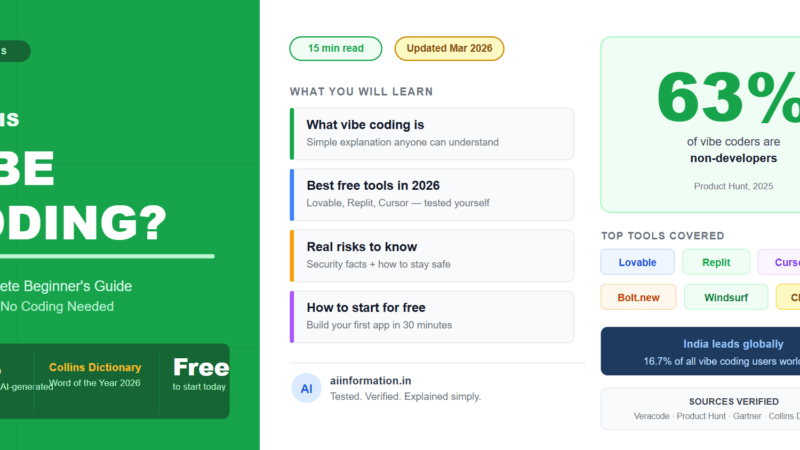
Quick Answer – What Is Vibe Coding? Vibe coding means building software by describing what you want in plain English — and letting AI write all the code for you. No programming skills needed. Coined by OpenAI co-founder Andrej Karpathy on February 2, 2025 and named Collins Dictionary’s Word of the Year for 2026, vibe coding now accounts for 41–46% of all new code written globally. Best free tools to start: Lovable, Replit, Bolt.new.
Twelve months ago, I thought “vibe coding” was a joke.
Not a mean joke – just a tech-bro joke. One of those phrases that sounds profound at a San Francisco conference and means nothing in the real world. Like “disruption” or “the metaverse.” I rolled my eyes and moved on.
I opened Replit on a Tuesday afternoon and typed a description of a habit tracker I had been wanting for months — something I’d always mentally filed under “would be nice if I knew how to code.” Ninety seconds later, the thing was running in my browser. Login screen, database, charts, the works. I hadn’t typed a single line of code. I had only typed English.
That was the moment this stopped being a joke and started being something I felt genuinely compelled to write about. Because here’s what I realised: the barrier between “I have an idea” and “I built the thing” has completely collapsed. And most people haven’t noticed yet.
This guide is my honest account of vibe coding in 2026 – what it is, what the verified numbers actually say, which tools genuinely work, what the real risks are, and how anyone reading this can start building today for free. No hype. No glossing over the problems. Just the full picture.
Table of Contents
What Is Vibe Coding — The Clearest Explanation You’ll Find
Vibe coding is a software development approach where you describe what you want an application to do using plain, conversational English — and an AI system generates all the actual code for you automatically.
You don’t write Python. You don’t learn JavaScript. You don’t wrestle with syntax errors at midnight. You describe what you want to build, as specifically as possible, and the AI translates your description into thousands of lines of working code across multiple files — instantly.
The name comes from a beautifully simple idea: you bring the vibe — your vision, your intention, the feeling of what you want to create — and the AI handles everything technical underneath.
Here is an analogy that actually captures it. Imagine you have an incredibly talented construction crew that speaks every language and knows every trade — plumbing, electrical, carpentry, everything. You don’t need to know how any of it works. You walk through and say “I want the kitchen here, the bedroom there, big windows facing east.” They build it. You adjust. They rebuild. That’s vibe coding. You are the architect with the vision. AI is your entire crew.
Vibe coding is also distinct from simply asking ChatGPT for code snippets. That is like asking someone to hand you bricks one at a time. Vibe coding is building the whole house in a single conversation, with the AI managing the architecture, the connections between components, the database, the styling — everything together as one coherent product.
Important distinction — vibe coding vs no-code tools: People often confuse vibe coding with no-code platforms like Bubble, Webflow, or Wix. The key difference is this: no-code tools use drag-and-drop interfaces and lock you into their platform’s limitations. Vibe coding generates real, exportable code — React, Python, Next.js, whatever is needed. You own it completely. You can take it anywhere. It is far more flexible and for building genuine custom software, it is dramatically more powerful.
The Man Who Named It — And Why the World Listened
Every generation-defining shift in technology has a moment of crystallisation — a point where someone puts a name to something already happening and suddenly everyone can see it clearly. For vibe coding, that moment came on February 2, 2025.
The person was Andrej Karpathy. A brief biography for context: he is a co-founder of OpenAI — yes, the company behind ChatGPT. Before that, he served as Senior Director of AI at Tesla, leading the team that built the self-driving neural network. He received his PhD from Stanford and studied under Geoffrey Hinton, one of the godfathers of deep learning. When Andrej Karpathy says something about AI, the entire tech world pays attention.
On that February morning, he posted something on X (formerly Twitter) that didn’t look earth-shattering at first. But within 72 hours it had spread to every tech newsletter, podcast, and engineering channel on the planet.
“There’s a new kind of coding I call ‘vibe coding’, where you fully give in to the vibes, embrace exponentials, and forget that the code even exists. […] I barely even touch the keyboard. […] I ‘Accept All’ always, I don’t read the diffs anymore. When I get error messages I just copy paste them in with no comment, usually that fixes it.”
— Andrej Karpathy, co-founder of OpenAI, X, February 2, 2025
Why did this hit so hard? Because Karpathy wasn’t just describing a technique — he was giving explicit permission. He was saying: it is okay to not understand every line of code. It is okay to let the AI drive. This is not cheating. This is the future. Coming from someone at his level of technical credibility, that permission meant something profound.
The cultural recognition that followed was significant:
- Merriam-Webster listed “vibe coding” as a trending slang expression within months of the original post
- Collins English Dictionary named it their Word of the Year for 2026 — one of the most prestigious recognitions a new word can receive
- MIT Technology Review included “Generative Coding” in its list of 10 Breakthrough Technologies for 2026
- The New York Times, Wall Street Journal, and Fast Company all ran major features on the phenomenon
- Even Linus Torvalds — creator of Linux — admitted publicly to vibe coding a Python tool for his own personal use in 2025, with his characteristically gruff caveat: nobody is vibe coding the Linux kernel
Then came the plot twist. In February 2026 — exactly one year after coining the term — Karpathy declared vibe coding “passé” and introduced a successor concept: agentic engineering. Same fundamental approach, but with professional discipline added: AI agents do the heavy lifting while humans actively oversee quality, security, and architecture. Vibe coding grown up. We will return to this.
How Vibe Coding Actually Works – Real Process, Real Prompts
Enough theory. Here is an actual vibe coding session the way it really works, with the real prompts that produce real results.
Scenario: You run a small tutoring business and want a booking website where parents can schedule sessions. Previously your options were: pay a developer ₹30,000–₹1,00,000, spend weeks learning WordPress, or just not have a website. Here is what vibe coding looks like instead.
Step 1 – Open a vibe coding tool and create a free account
Go to Lovable.dev or Replit.com. Sign up free — no credit card, no download. Everything runs in your browser. This takes under two minutes.
Step 2 – Write a detailed, specific description of what you want
This is your “code.” Specificity is everything. Don’t type “make me a website” — that produces something generic. Instead, write something like this:
“Build me a professional tutoring website. Homepage with my name (Priya Sharma), a short about section, and the subjects I teach — Maths, Science, English for classes 6 to 10. I need a booking form where parents enter their child’s name, class, preferred time slot, and contact number. The form should show a confirmation message after submission. Make it mobile-friendly, clean design, blue and white colour scheme, with a WhatsApp contact button.”
Step 3 – Watch the AI generate a complete working site
In 30 to 90 seconds, a fully functional website appears with real pages, real forms, real navigation. The AI likely generated 400 to 800 lines of code across multiple files. You wrote zero of them.
Step 4 – Test it, then give feedback in plain English
Click around. Check the form. Check mobile view. Then describe changes: “The heading font is too small. Move the WhatsApp button to the top right corner. Add a section showing my qualifications with a simple bullet list.”
Step 5 – When errors appear, paste them back with no explanation
If something breaks, copy the exact error message and paste it straight back to the AI with no other comment. In testing, it resolves correctly on the first attempt about 70–80% of the time. No debugging knowledge needed whatsoever.
Step 6 – Publish with one click
Lovable, Replit, and Bolt.new all publish to a real URL with a single button. No server setup. No domain configuration. No technical knowledge required. Your tutoring website is live on the internet.
The single habit that doubles your results: Before opening any tool, spend five minutes writing out everything you want — every feature, every section, every colour preference, every button. The quality of your output is directly proportional to the specificity of your description. Vague prompts produce generic results. Detailed prompts produce surprisingly professional ones.
Who Is Actually Using Vibe Coding in 2026
Here is the number that reframes everything: according to the 2025 State of Vibe Coding report published by Product Hunt, 63% of vibe coding users are not professional developers.
The majority of people using this technology to build real software have no coding background at all. They are teachers, small business owners, designers, students, entrepreneurs, researchers — people who had ideas and previously had no way to execute them without hiring someone or spending years learning to code.
Real story – The personal trainer
A personal trainer with zero technical background launched a fitness tracking app that received thousands of downloads in its first month. Not a prototype — an actual app with real users. His advantage had nothing to do with coding: he understood exactly what fitness clients needed, having trained hundreds of them. He described those needs with perfect clarity. The AI handled the rest. His own words: “I spent ten years thinking I needed to learn to code to build this. Turns out I needed to learn to describe.”
Real story – Y Combinator startups, 2025
In Y Combinator’s Winter 2025 batch — the world’s most prestigious startup accelerator — 21% of companies had codebases that were 91% or more AI-generated. These are funded companies pitching to investors and serving real customers with products built almost entirely through vibe coding. Some have since raised follow-on funding.
Real story – India leads the world
For Indian readers specifically: according to the Product Hunt State of Vibe Coding 2025 report, India is the single largest contributor to vibe coding adoption globally, accounting for 16.7% of all vibe coding users worldwide. The APAC region — led by India — accounts for 40.7% of total global usage. India’s combination of large developer community, English proficiency, and entrepreneurial culture has made it the world’s vibe coding capital. If you are in India, you are already at the epicentre of this movement.
Real story – The world’s biggest companies
Walmart saved 4 million developer hours using AI coding tools. Booking.com achieved 65% developer adoption and saved 150,000 hours in year one. At Accenture, 67% of developers use GitHub Copilot at least five days per week. 87% of Fortune 500 companies have now adopted at least one vibe coding platform. This is not an experiment at the edges — it is mainstream enterprise infrastructure.
The Statistics – Verified Data, Not Marketing Numbers
I want to be honest about statistics here. Many vibe coding articles cite numbers from companies that profit from selling vibe coding tools — which is like asking McDonald’s how healthy their burgers are. The figures below are cross-referenced against independent research and academic sources.
| Metric | Number | Source |
|---|---|---|
| US developers using AI coding tools daily | 92% | Second Talent Research, Jan 2026 |
| All new code globally that is AI-generated | 41–46% | Second Talent / getpanto.ai, 2026 |
| Vibe coding users who are non-developers | 63% | Product Hunt State of Vibe Coding 2025 |
| New software code that will be AI-generated by end of 2026 | 60% (forecast) | Gartner, 2025 |
| AI-generated code samples that fail security tests | 45% | Veracode GenAI Code Security Report 2025 |
| Cursor valuation in 2026 | $10 billion | Market reports, 2026 |
| GitHub Copilot users added in Q2 2024 alone | 5 million | GitHub, 2024 |
| VC investment in generative AI in 2024 | $56 billion | Industry data, 2024–2025 |
One number deserves extra attention: independent analysis from getpanto.ai notes that while output velocity increases significantly, vibe coding simultaneously increases review burden, defect risk, and organisational knowledge decay when safeguards are not in place. Speed gains at the front are real — but they create hidden costs downstream. The honest picture is faster development and new risks. Both halves matter equally.
Vibe Coding vs Traditional Coding – The Honest Comparison
The question I get asked constantly: “Does vibe coding replace traditional programming?” The short answer is no. The longer answer is more interesting.
| What you’re comparing | Traditional coding | Vibe coding |
|---|---|---|
| What you actually write | Every line of code manually in a programming language | Plain English descriptions and feedback |
| Skills needed to start | Programming language, frameworks, logic, debugging | Ability to describe what you want clearly |
| Time before first working product | 6 months to 2+ years of learning first | 30–90 minutes on your very first session |
| Cost to build a basic app | ₹30,000–₹5,00,000 hiring a developer | Free to ₹2,000 per month with AI tools |
| Speed of changes | Hours to days per feature update | Minutes per change |
| Code quality and security | High when written by experienced developers | Variable — 45% of AI code fails security tests |
| Error fixing | You debug yourself — requires technical knowledge | Paste error back to AI — fixes itself 70–80% of the time |
| Best for | Complex, secure, scalable production systems | Prototypes, MVPs, personal tools, side projects |
| Long-term maintenance | Easier — code is written intentionally and understood | Harder — AI code accumulates technical debt after ~15 components |
Research from the University of Michigan found that experienced developers who fully vibe code — accepting all AI output without review — produce code comparable to junior developers in quality. Skill still matters. The best outcomes consistently come from combining vibe coding speed with human review and judgment.
My honest view after testing this extensively: these approaches are not opponents. They are teammates. Senior developers use vibe coding to do in one hour what used to take a full day. Beginners use it to build things they never could before. Both are valid. Treating this as either/or misses the actual opportunity entirely.
Best Vibe Coding Tools in 2026 — Tested, Not Just Listed
There are now over 20 serious vibe coding tools available. I have personally used the major ones across multiple sessions. Here is my honest breakdown — no sponsorships, no affiliate arrangements.
| Tool | Best for | Free plan | Paid from | Rating |
|---|---|---|---|---|
| Lovable — Top pick for beginners | Complete beginners building web apps. Fastest growing platform right now. | Yes | ~$20/mo | 5/5 |
| Replit | Students and learners. Browser-based, strong free tier, great community. | Yes | $7/mo | 4.5/5 |
| Bolt.new | Speed. Fastest way to get a full-stack web app prototype running. | Yes (limited) | $20/mo | 4.5/5 |
| Cursor — Developer standard | Developers wanting AI in their editor. $10B valuation. Industry standard in 2026. | Yes | $20/mo | 5/5 |
| Windsurf | Advanced developers. Arena Mode lets you compare AI models side by side. | Yes | $15/mo | 4.5/5 |
| GitHub Copilot | Developers already using VS Code. Free for students. 20 million+ users. | Students free | $10/mo | 4/5 |
| Claude Code | Complex multi-file codebases. Terminal-based. Fastest growing AI dev tool. | No | ~$20/mo | 4.5/5 |
| v0 by Vercel | Front-end UI components. Blocked 17,000 insecure deployments in one month. | Yes | $20/mo | 4/5 |
My recommendation for beginners.
Start with Replit or Lovable. Both work entirely in your browser, have solid free tiers, and are built specifically for non-coders. Replit has particularly strong adoption in the Indian student community. I built a working to-do app with categories, deadlines, and a progress dashboard in Replit in 11 minutes during my first real test session.
If you are a developer looking to accelerate your workflow, Cursor is where the industry has landed in 2026. Its $10 billion valuation reflects real adoption — developers who switch to it rarely return to their previous setup.
The Real Risks — Honest, Not Scary
Every guide about vibe coding wants to be cheerful and positive. The technology genuinely is exciting — but glossing over the risks does not help you. You will hit them anyway and be less prepared. Here is the full picture.
Risk 1 — Security vulnerabilities you cannot see
A 2025 GenAI Code Security Report by Veracode found that 45% of AI-generated code samples fail security tests and contain critical vulnerabilities including cross-site scripting and SQL injection — both in the OWASP Top 10 most dangerous web vulnerabilities. A Stanford study found that AI-assisted developers produce more vulnerable code while simultaneously believing it is more secure. Confidence goes up. Quality goes down.
In 2025, Lovable itself had 170 out of 1,645 generated applications with misconfiguration issues allowing unauthorised access to personal data. That is roughly a 10% rate on a platform specifically designed for vibe coding.
What to do: For personal tools and prototypes — build freely. For any app handling real users, account data, health information, or payments — have a developer perform a security review before launch. This is not optional when real users are involved.
Risk 2 — The quality cliff after 15 components
Fast Company reported the “vibe coding hangover” in September 2025, and independent analysts predict up to $1.5 trillion in accumulated technical debt by 2027 from AI-generated code that was not properly reviewed or structured. Here is what actually happens: the first 10–15 components of any vibe-coded project come together beautifully. Then the codebase starts to tangle. The AI loses track of earlier decisions. Errors multiply. Changes break things that previously worked.
What to do: For small contained projects you will never hit this. For anything larger, periodically ask the AI to “review and refactor the codebase for clarity and consistency.” It reorganises its own work surprisingly well when prompted explicitly.
Risk 3 — The last 20% problem
Vibe coding gets you to 80% of a finished product at remarkable speed. The final 20% — true production readiness, scalability, proper security, comprehensive testing — still benefits enormously from real engineering expertise. Many people build impressive prototypes, show them to investors or customers, get excited by the reaction, and then discover they cannot scale the thing.
What to do: Match your approach to your actual goal. Personal tool? Vibe code the whole thing. Startup product you plan to scale? Use vibe coding to validate your idea and build your MVP — then bring in engineering expertise before serious growth.
Risk 4 — Knowledge decay
When teams vibe code extensively without reviewing the output, nobody actually understands what was built. When something breaks six months later, there is no one who can fix it because no one understood it to begin with. The code becomes a black box that works until it does not.
What to do: Even without technical expertise, regularly ask the AI to explain what it built and why. Build a basic understanding of your own product’s architecture. This requires curiosity, not technical skill.
How to Start Vibe Coding Today — Free, Right Now
No more theory. Here are your exact first steps, whether you have never touched code or you are a senior developer.
Step 1 — Go to replit.com and create a free account
No credit card. No download. Just an email address. The account setup takes two minutes. This is where you will build your first vibe-coded project.
Step 2 — Click “Create Repl” then choose “Use AI to build”
This mode is right on the dashboard. It opens the AI builder interface where you describe what you want to create.
Step 3 — Build something you actually want, not a practice project
The most common beginner mistake is building a fake practice app they have no real use for. Build something real — a tool you will actually use. A habit tracker, a simple invoice generator, a quiz for your students, a contact form for your freelance work. Real motivation produces better descriptions. Better descriptions produce better results.
Step 4 — Describe changes in plain English
“The button colour should be dark blue.” “Move the header image to be full-width.” “Add a thank-you message after the form is submitted.” Every adjustment is just a sentence. There is no wrong way to describe what you want.
Step 5 — Share the link — your app is live
Replit gives you a real, shareable URL automatically. Send it to someone. See what they think. That feedback is more valuable than anything you will read in any tutorial.
Realistic expectation for your first session: 20 to 60 minutes to get something genuinely working. It will not be perfect — that is completely normal. Your second attempt will be faster. Your fifth attempt will produce something you would be genuinely proud to share. The learning curve in vibe coding is not “learn syntax” — it is “learn to describe precisely.” Most people develop this skill surprisingly fast because it is fundamentally human.
Where Vibe Coding Is Going Next
Even Karpathy — who coined the term — has already moved past it. In February 2026 he introduced agentic engineering: the same AI-powered approach, but with engineering discipline layered on top. AI agents doing the heavy lifting while humans actively review quality, security, and architecture. Vibe coding with professional accountability.
Several clear trends are emerging for what comes next:
- AI code review will become mandatory. Tools like v0 by Vercel already blocked 17,000 insecure deployments in a single month. Security scanning built into the publishing workflow will become standard within 12 months.
- Prompt management becomes a formal skill. Writing effective, precise prompts for code generation will be treated as a professional discipline — with tooling, standards, and versioning like any other engineering artifact.
- The 46% becomes 70%+ — but as AI writes more code, the value of humans who deeply understand what AI is building increases, not decreases.
- India will lead globally. With the fastest-growing developer community in the world and already 16.7% of global adoption, India is positioned to define how this technology develops across Asia and increasingly the world.
Gartner’s prediction that 60% of all new software code will be AI-generated by end of 2026 looked bold when made. Based on current adoption rates, several analysts now think it is actually conservative.
Update — March 20, 2026: One day after this guide was published, Google launched full-stack vibe coding directly inside Google AI Studio. Their new Antigravity agent now builds real apps with an actual database, real user login, and real-time multiplayer – all set up automatically from a text description. The main limitation I described in the risks section above – that vibe coding could not handle real backends – has been directly addressed. I wrote a full breakdown here: Build Real Apps Free With No Code – Google AI Studio Vibe Coding.
My Honest Final Verdict
I have spent years testing AI tools. Most of them deliver perhaps 30% of what they promise. Vibe coding is different. It delivers on its core promise — that anyone can build real software — while being genuinely honest about its limitations around security, quality, and technical debt. That combination of real capability plus real tradeoffs is rare in this space.
The personal trainer who launched a fitness app. The teacher who built an educational platform. The Y Combinator founders who raised investment on vibe-coded products. The 63% of users who are not professional developers. These are documented, verified outcomes from real people who had ideas and used available tools to execute them.
Collins Dictionary did not name vibe coding Word of the Year for 2026 because it is a passing trend. They named it because it represents a documented, measurable shift in how software gets built — one that is still accelerating. Gartner, MIT Technology Review, and multiple independent research organisations have reached the same conclusion from different directions.
The question is not whether vibe coding deserves your attention. It clearly does. The question is what you are going to build with it.
What is the first thing you want to build?
Drop it in the comments below — I read every one and often reply with specific tool recommendations for your exact use case. If this guide helped you, share it with someone who has always wanted to build an app but assumed they could not.
Frequently Asked Questions About Vibe Coding
What is vibe coding in simple words?
Vibe coding means building software by describing what you want in plain English and letting an AI write all the actual code for you. You do not need to know any programming language. You focus on what you want to create; the AI handles all the technical work underneath. Anyone who can clearly describe their idea can build real working software with vibe coding.
Who invented vibe coding?
Vibe coding was coined by Andrej Karpathy — co-founder of OpenAI and former AI Director at Tesla — in a post on X on February 2, 2025. He described letting AI write all code while he barely touched the keyboard. The term went viral immediately and was named Collins Dictionary’s Word of the Year for 2026.
Can a complete beginner with zero coding experience do vibe coding?
Yes — and this is precisely what the technology is designed for. According to the 2025 State of Vibe Coding report by Product Hunt, 63% of all vibe coding users are non-developers with no programming background. Tools like Lovable, Replit, and Bolt.new are built specifically for this audience. The skill you need is the ability to describe what you want clearly and specifically — something most people can do on day one.
What are the best vibe coding tools for beginners in 2026?
For complete beginners: Lovable (fastest growing, excellent for web apps), Replit (great for students, strong free tier), and Bolt.new (best for speed). For developers: Cursor (the industry standard, $10 billion valuation in 2026) and Windsurf (strong multi-model support). For complex codebases: Claude Code. Almost all have meaningful free plans so you can start without spending anything.
Is vibe coding safe for apps used by real people?
For personal tools, portfolios, and prototypes — yes. For apps handling real users, their data, health information, or payments — be careful. A 2025 Veracode report found 45% of AI-generated code samples fail security tests. A Stanford study found AI-assisted developers produce more vulnerable code while believing it is more secure. Always have code reviewed by someone with security expertise before deploying to real users at scale.
Is vibe coding free?
Yes — several major tools have solid free plans. Replit, Bolt.new, Cursor, v0 by Vercel, and Google Firebase Studio all let you build real projects without paying. Paid plans range from $7 to $20 per month for higher usage limits and advanced features. For most beginners the free tiers are more than enough to build and publish their first several projects.
What is agentic engineering and how is it different from vibe coding?
Agentic engineering is the evolved successor to vibe coding introduced by Andrej Karpathy in February 2026. The core approach is identical — AI does the coding work — but agentic engineering adds professional engineering discipline: humans actively oversee what is being built, review outputs for quality and security, and apply proper software engineering principles rather than just accepting everything the AI generates. It is vibe coding with maturity and accountability added on top.
More from AI Information:
What Is an AI Agent? The Complete Guide (2026)
Sources and References
- Second Talent Research — Top Vibe Coding Statistics 2026 (January 24, 2026)
- Product Hunt — The State of Vibe Coding 2025 (October 13, 2025)
- getpanto.ai — Vibe Coding Statistics: Productivity and Risk in AI-Assisted Development (February 2026)
- Veracode — GenAI Code Security Report 2025
- Gartner — Forecast: 60% of new software code AI-generated by 2026 (2025)
- The New Stack — Vibe Coding is Passé: Karpathy Introduces Agentic Engineering (February 10, 2026)
- MIT Technology Review — 10 Breakthrough Technologies 2026 (January 12, 2026)
- Collins English Dictionary — Word of the Year 2026
- Google Cloud — What Is Vibe Coding? (cloud.google.com)
- Andrej Karpathy — Original X post, February 2, 2025

Leave a Reply