

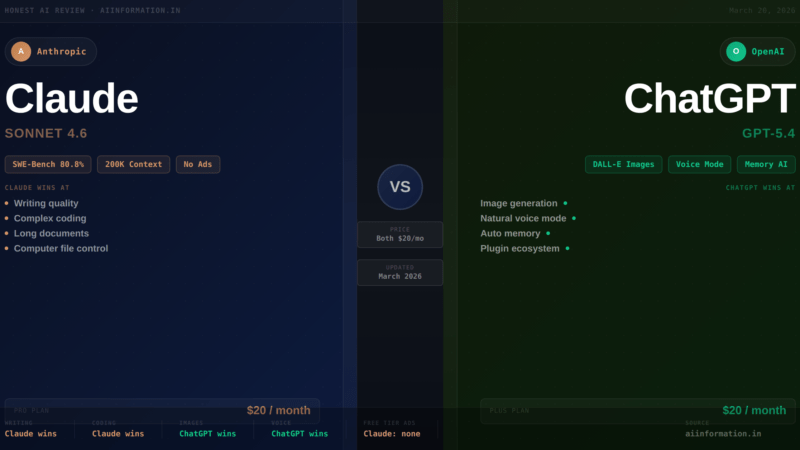
Many people ask: is Claude AI better than ChatGPT in 2026? The honest answer depends entirely on what you use it for. Claude AI is better than ChatGPT for writing, coding, and handling long documents. ChatGPT is better for image generation, voice mode, and everyday quick tasks.Both cost $20 per month for the paid tier. Both have a free version. Neither is clearly better at everything.
The real question is: what do YOU specifically need it for? This review gives you a straight answer based on tested data, not marketing copy.
Table of Contents
The Story Behind Claude Hitting Number One in 2026
In early 2026, something happened that nobody in the AI industry predicted.
Claude AI hit the number one spot on the App Store. For the first time since ChatGPT launched in November 2022, OpenAI was not at the top. Anthropic knocked them off.
The reason was not a new feature. It was not a benchmark win. It was a values decision.
Anthropic publicly refused the Pentagon’s demand to deploy Claude for autonomous weapons systems and mass surveillance programmes. The government responded by labelling Anthropic a “supply chain risk.” Instead of backing down, Anthropic held their position.
The reaction from users was immediate. People who backed Anthropic’s stance switched from ChatGPT en masse. Signups tripled. Paid subscriptions more than doubled in a matter of months. Claude’s App Store number one ranking reflected that shift as much as it reflected product quality.
I am telling you this story before the feature comparison because I think it matters. By the end of this review you will know which AI is technically better for specific tasks. But which company you give your $20 a month to is also a question worth thinking about consciously.
With that said, let us get into the actual product.
What Is Claude AI? Two-Minute Explainer
Claude is an AI assistant built by Anthropic, a safety-focused AI company founded in 2021 by former OpenAI researchers including Dario Amodei and Daniela Amodei.
If ChatGPT is the AI tool most people know, Claude is the AI tool that people who use AI seriously tend to prefer. It is built around a framework called Constitutional AI, which means it is trained to be honest, to acknowledge uncertainty, and to decline requests it considers harmful rather than just producing whatever answer keeps you engaged.
In practice, Claude feels different to use than ChatGPT. It is more careful, more thorough, and more likely to push back if it thinks you are wrong about something. Some people find this frustrating. Others find it exactly what they needed.
As of March 2026, the current Claude models are Claude Opus 4.6 (most capable), Claude Sonnet 4.6 (balanced, what most users interact with by default), and Claude Haiku 4.5 (fastest and cheapest).
Pricing Comparison: Claude vs ChatGPT (All Tiers, March 2026)
| Plan | Claude | ChatGPT |
|---|---|---|
| Free | Free (limited messages, Sonnet 4.6 access) | Free (GPT-5 access, now shows ads since Feb 2026) |
| Standard Paid | Pro at $20/month ($17 billed annually) | Plus at $20/month |
| Power User | Max at $100/month (5x Pro usage) | Pro at $200/month |
| Maximum | Max at $200/month (20x Pro usage) | Enterprise (custom) |
| Team | Team at $25/seat/month (annual) or $30 monthly | Team at $30/seat/month |
| Ads on free tier | No ads on any tier | Yes, ads added Feb 2026 on Free and Go tiers |
One fact worth noting: ChatGPT introduced ads on its free and Go tiers in February 2026. Claude has no ads on any tier. For people who use the free version daily, this is a meaningful practical difference.
What Claude Pro Gets You at $20
- 5x more messages than the free tier
- Access to Claude Code in the terminal
- File creation and code execution
- Google Workspace integration (read and edit your Docs, Gmail, Drive)
- Remote MCP connectors to integrate other tools
- Extended reasoning capabilities
- Claude Cowork: agentic feature for multi-step autonomous tasks (added January 2026)
- Priority access during peak times
What ChatGPT Plus Gets You at $20
- GPT-5.4 access
- DALL-E image generation
- Voice mode
- Web browsing
- Advanced Data Analysis (runs actual code)
- Custom GPTs
- Higher daily message limits than free
Both plans cost the same. The feature sets are genuinely different, which is why neither is objectively “better value” without knowing what you need.
The Free Tier Honest Comparison
Most people reading this start on the free tier. So this section matters more than the paid comparison for most readers.
Here is the honest picture on free Claude vs free ChatGPT in March 2026:
| Feature | Claude Free | ChatGPT Free |
|---|---|---|
| AI model | Claude Sonnet 4.6 | GPT-5 (base) |
| Daily message limit | Limited, resets every 5 hours | Limited, resets every 5 hours |
| Image generation | No | Yes (limited) |
| Voice mode | No | Yes (limited) |
| Web search | Basic | Yes |
| Ads | No ads | Yes, ads since Feb 2026 |
| Context window | 200K tokens | 128K tokens |
| Document analysis | Yes, excellent | Yes, good |
| Writing quality | Higher | Good, more versatile |
My honest take on the free tier: if you need image generation or voice, use ChatGPT free. If you write a lot, analyse documents, or just do not want ads interrupting your work, Claude free is the better daily driver. So is Claude AI better than ChatGPT for coding specifically? The benchmark data says yes.
The free tier on both platforms hits limits fast for heavy users. If you use either more than 1 to 2 hours daily, you will need to pay eventually.
Writing Quality: Who Actually Writes Better?
This is where Claude separates itself most clearly, and the evidence is consistent across multiple independent testers.
Tom’s Guide ran 7 real-world tests in March 2026 comparing Claude Sonnet 4.6 against ChatGPT 5.2. Their conclusion: Claude came out ahead almost every time with deeper strategic thinking, stronger real-world framing, and a clearer understanding of trade-offs. ChatGPT performed better on clarity and accessibility for simple explanations.
In a 2026 essay writing benchmark, Claude produced more coherent long-form content, scoring 85% on structure compared to ChatGPT’s 78%.
From real user experience: Claude is less likely to write in the robotic patterns that scream AI. No “In conclusion,” no “It is important to note that,” no “Certainly! Here is a comprehensive overview.” Claude sounds more like a person wrote it. For anyone writing blog posts, professional emails, or long reports, this matters enormously.
ChatGPT is faster for creativity and ideation. Need 50 headline ideas in two minutes? ChatGPT is better for that. Need a 2,000-word analysis that actually sounds intelligent? Claude is better for that.
One genuine ChatGPT advantage: it is more flexible with tone. Ask both to rewrite something like a pirate and ChatGPT will dive in enthusiastically. Claude will do it but more cautiously. For playful, experimental writing, ChatGPT wins. For serious professional writing, Claude wins.
Coding: What the Benchmarks Actually Say
The 2026 coding benchmarks tell a clear story, and it is in Claude’s favour.
On SWE-Bench Verified, the most respected real-world software engineering benchmark that tests ability to resolve actual GitHub issues:
- Claude Opus 4.6: 80.8%
- Gemini 3.1 Pro: 80.6%
- GPT-5.4: 77.2%
That 3.6 percentage point gap is meaningful in practice, especially on complex multi-file tasks. Claude also has a larger context window at the standard tier (200K tokens vs ChatGPT’s 128K), which matters enormously when working on large codebases where the AI needs to understand dozens of files simultaneously.
Where ChatGPT still wins on coding: speed for simple tasks, better plugin support, and Advanced Data Analysis which actually runs code rather than just generating it. For a developer who needs to test data quickly, ChatGPT’s code execution environment is genuinely useful.
For developers building complex features, refactoring large codebases, or debugging across multiple files: Claude. For quick scripts, boilerplate code, and common patterns: either works, ChatGPT is slightly faster.
Long Documents and Context Window
This is Claude’s clearest practical advantage for everyday users.
Claude’s context window at the standard tier is 200,000 tokens. That is roughly 150,000 words or the equivalent of a full novel. In beta, Claude Opus 4.6 supports up to 1 million tokens.
ChatGPT Plus offers 128K tokens. Better than it used to be, but still significantly smaller.
In practice: if you want to paste an entire 50-page report and ask questions about it, Claude handles this without breaking a sweat. If you want to upload your entire codebase for a review, Claude can hold it all in memory at once. If you are analysing a legal document, a research paper, or a long business plan, Claude’s larger context window means fewer “I seem to have lost track of what we were discussing” moments.
For anyone who works with long documents regularly, this single difference makes Claude clearly the better choice at the same price point.
Image Generation and Multimedia
Claude cannot generate images. Full stop.
ChatGPT has DALL-E built in. You can describe any image and get one generated immediately within the same chat. For designers, marketers, social media managers, or anyone who regularly needs visual assets, this is a significant feature gap.
Claude can analyse images you upload, read graphs, extract information from screenshots, and describe what it sees with excellent accuracy. But it cannot create images from text descriptions.
On video analysis, Gemini 3.1 actually beats both Claude and ChatGPT. On voice mode, ChatGPT’s conversation feels more natural and less robotic than the alternatives.
Honest summary: if images or voice are core to your workflow, ChatGPT is the better choice today. Claude’s roadmap suggests multimedia capabilities are coming, but as of March 2026, the gap is real.
Memory and Personalisation
ChatGPT has a stronger memory system currently. GPT-5 actively observes your conversations, learns your preferences over time, and can tell you things about yourself based on patterns it has noticed. In practice, this means ChatGPT increasingly knows how you like information presented, what topics you work on, and what your communication style is.
Claude has memory on the Max tier ($100/month). On Free and Pro, memory is limited to what you provide within a conversation or through Projects. Claude’s Projects feature lets you create persistent contexts for different work areas, which partially fills the gap, but it requires you to actively set it up rather than happening automatically.
For users who want AI that genuinely learns who they are over time without any effort on their part, ChatGPT is ahead here.
Agentic Capabilities in 2026
Both platforms can now take actions on your behalf, not just answer questions. This is the most significant evolution in both products in 2026.
Claude Cowork, launched January 12, 2026, is currently the more capable agentic option. It can browse the web AND control your computer’s actual files and folders. You can ask it to organise your downloads folder, process files across your desktop, and handle multi-step tasks that go beyond what a browser agent can do. ChatGPT’s agent mode operates through a virtual browser and does not touch your local file system.
Claude Cowork expanded to all Pro subscribers on January 16, 2026, making it available at the $20 tier. This was a significant upgrade that most comparison articles have not fully covered yet.
Both platforms can book things, research topics, fill forms, and navigate websites. When they work, they are genuinely impressive. When they fail, they can do so in confusing ways that require cleanup. Neither is fully reliable for fully autonomous tasks yet. Claude has the edge in what it can access, ChatGPT has the edge in how stable its browser-based tasks perform.
Safety and Values: Why This Matters in 2026
Three years ago, nobody would have expected “which company has better values” to be a practical consideration in choosing an AI tool. In 2026 it is.
Anthropic built Claude on Constitutional AI, a framework where the model is trained to follow ethical principles rather than just user compliance. In practice, Claude will sometimes decline requests that ChatGPT handles without hesitation. It is more likely to say “I am not certain about this” than to produce a confident wrong answer. It is less sycophantic, meaning it will tell you when your plan has problems rather than just agreeing with everything you say.
The Pentagon incident described at the start of this article made this concrete rather than philosophical. Anthropic drew a line and held it even when the government threatened retaliation. Whether that matters to your tool choice is a personal decision. But for a significant number of people, it has already changed which platform they pay for.
ChatGPT operates under OpenAI’s guidelines, which have evolved considerably since the company’s founding. OpenAI is less public about specific ethics decisions and has faced ongoing internal debates about mission versus commercial pressure. The product is excellent. The company’s direction is more opaque.
Who Should Use Claude, Who Should Stick With ChatGPT
Use Claude if:
- You write professionally and want output that does not sound like AI
- You work with long documents, research papers, or large codebases
- You code seriously and want the most accurate complex solutions
- You value honesty over agreeableness in AI responses
- You want AI that pushes back when your idea has problems
- You do not want ads in your AI tool
- You need agentic control over your actual computer files
- You use Google Workspace and want AI integrated into it
Stick With ChatGPT if:
- You need image generation as part of your regular workflow
- You use voice mode frequently
- You want AI that learns your personality automatically over time
- You rely on the ChatGPT plugin ecosystem
- You need quick creative ideation or brainstorming at high volume
- You are already deeply embedded in the OpenAI ecosystem with custom GPTs
- You use ChatGPT for customer-facing chatbots or integrations
Use Both (honestly, this is what most serious users do):
The most common pattern among people who use AI tools professionally is Claude for writing, deep analysis, and complex coding combined with ChatGPT for image generation, voice interactions, and quick creative tasks. At $20 each, many people pay for both. If you are choosing just one, the decision comes down to whether images and voice outweigh writing quality and context window for your specific work.
The Honest Verdict
The honest answer to “Is Claude better than ChatGPT?” is yes, for specific things, and no, for other specific things.
Claude is the better tool for writing, long-form analysis, complex coding, and working with large documents. Claude Opus 4.6 beats GPT-5.4 on the most respected coding benchmarks. Claude’s writing sounds more human. Claude’s 200K context window beats ChatGPT at the same price. Claude has no ads.
ChatGPT is the better tool for image generation, voice, memory, ecosystem breadth, and quick creative tasks. ChatGPT has DALL-E. ChatGPT’s voice mode is genuinely better. ChatGPT remembers you automatically. ChatGPT has a larger plugin and integration ecosystem.
Both cost $20 per month. Neither is worth paying for until you have actually used the free version and know what you need it for. Start free on both. Decide based on your actual usage, not a comparison article.
If I had to choose one: Claude, for the writing quality and context window alone. But I use both, and I think most people who work seriously with AI end up there too.
Questions People Are Searching Right Now
Is Claude AI free?
Yes. Claude has a free tier accessible at claude.ai with no credit card required. It gives you access to Claude Sonnet 4.6 with limited daily messages. The free tier is genuinely useful for moderate use but will hit limits if you use it heavily throughout the day. There are no ads on any Claude tier, including free.
Is Claude AI Better Than ChatGPT for Writing?
Yes, consistently. Multiple independent tests in 2026 confirm Claude produces more natural, less robotic writing. It scores higher on long-form content benchmarks. It is less likely to use the filler phrases and over-explaining patterns that make AI writing obvious. For anyone producing professional written content, Claude is the clearer choice.
Does Claude AI have image generation?
No. Claude cannot generate images as of March 2026. It can analyse images you upload, read graphs, and extract information from screenshots, but it cannot create images from text descriptions. For image generation you need ChatGPT (DALL-E) or a dedicated image tool like Midjourney.
Why did Claude hit number one on the App Store?
In early 2026, Anthropic publicly refused the Pentagon’s demand to deploy Claude for autonomous weapons and mass surveillance. The government labelled Anthropic a “supply chain risk.” Users who backed Anthropic’s decision switched from ChatGPT in significant numbers. Signups tripled and paid subscriptions more than doubled, driving Claude to the number one App Store position for the first time.
What is Claude Cowork?
Claude Cowork is an agentic feature launched January 12, 2026, that allows Claude to autonomously complete multi-step tasks involving your computer’s actual file system. Unlike ChatGPT’s agent which only operates in a virtual browser, Cowork can access your desktop, downloads folder, and local files. It expanded to all Pro subscribers on January 16, 2026, making it available at the $20/month tier.
Is Claude Pro worth $20 a month?
If you use AI for professional writing, coding, or document analysis more than 2 hours daily, yes. The free tier limits will interrupt your workflow before you reach 2 hours of active use. Claude Pro at $20 gives 5x more usage, Google Workspace integration, Claude Code access, and Cowork agentic capabilities. One research report, one article, or one coding session that would have been interrupted on the free tier justifies the monthly cost quickly.
Is Claude safer than ChatGPT?
Anthropic publishes more transparency about their safety approach through Constitutional AI and their model cards. In practice, Claude is more likely to decline questionable requests and more likely to express uncertainty rather than produce confident wrong answers. Whether “safer” is meaningful depends on your use case. For general professional and personal tasks, both are safe tools.
What model does Claude use?
As of March 2026, Claude runs on the Claude 4.6 model family. Claude Sonnet 4.6 is what most users interact with by default. Claude Opus 4.6 is the most capable model, released February 5, 2026, with features including agent teams, 1 million token context window in beta, and extended thinking. Claude Haiku 4.5 is the fastest and cheapest option.
What is the main difference between Claude and ChatGPT?
The most practical difference is what each excels at. Claude is built for writing quality, long-document analysis, and complex coding. ChatGPT is built for versatility, including image generation, voice interaction, and broad task coverage. Both cost $20/month for the paid tier. The right choice depends entirely on your primary use case.
Can I use Claude and ChatGPT together?
Yes, and many professional AI users do. A common workflow is Claude for writing and analysis, ChatGPT for image generation and voice tasks. Both have free tiers so you can run both without paying. If you use AI heavily enough to pay for one, you might find paying for both worthwhile depending on your work.
Is Claude better for students?
For research, essay writing, and analysing long academic papers, yes. Claude’s 200K context window means you can paste entire research papers and ask questions about them. Its writing quality makes it less likely to produce the obviously AI-written content that can flag plagiarism detection. ChatGPT is better for quick questions and image creation for presentations.
Does Claude remember previous conversations?
On the free and Pro tiers, Claude does not automatically remember across separate conversations. You can use Projects to create persistent contexts for different work areas, and you can manually tell Claude information to remember within a conversation. Automatic memory that learns without effort is a Max tier feature ($100/month). ChatGPT has automatic memory learning on its paid tiers.
Key Takeaways
- Claude hit the App Store number one in early 2026 after Anthropic refused Pentagon weapons deployment demands, not from a feature update
- Both Claude Pro and ChatGPT Plus cost $20 per month with genuinely different feature sets
- Claude wins clearly on writing quality, long documents, and coding benchmarks (80.8% vs 77.2% on SWE-Bench)
- ChatGPT wins clearly on image generation, voice mode, and automatic memory
- ChatGPT free tier now shows ads since February 2026. Claude has no ads on any tier
- Claude Cowork (launched Jan 2026) gives Claude agentic control over your actual computer files, not just a virtual browser
- Claude has 200K token context window at the standard tier vs ChatGPT’s 128K
- Most serious AI users end up using both for different tasks rather than choosing one exclusively
- Start free on both before paying. Decide based on what you actually use it for
I have been testing both tools since before most people had heard of Claude. My honest answer in March 2026 is the same as it has been for a year: they are different tools that happen to cost the same amount. The people who get the most out of AI are the ones who understand what each one is built for and use them accordingly.
If you are still deciding: try Claude free today at claude.ai and ChatGPT free at chatgpt.com. Use both for a week on your actual daily tasks. The right answer will become obvious.
Stay ahead of every AI change as it happens.
The Sunday AI Digest covers the most important AI developments of the week, explained simply. Free forever. Subscribe here.
Related Articles
- What Is an AI Agent? The Complete Guide (2026)
- What Is Agentic AI? 2026’s Biggest Tech Shift Explained
- What Is Vibe Coding? Complete Beginner’s Guide (2026)
- Build Real Apps Free With No Code: Google AI Studio Vibe Coding
Sources
- Anthropic Official Pricing and Documentation (March 2026) at claude.ai/pricing
- FelloAI: Claude vs ChatGPT Comparison March 2026 at felloai.com
- Tom’s Guide: 7 Real-World Tests Claude vs ChatGPT (March 2026) at tomsguide.com
- Zapier: Claude vs ChatGPT Comparison (Updated March 2026) at zapier.com
- SWE-Bench Verified Benchmark Data (February 2026)
- Screenapp: Claude AI Pricing Tested Across All Tiers (February 2026) at screenapp.io



Leave a Reply