

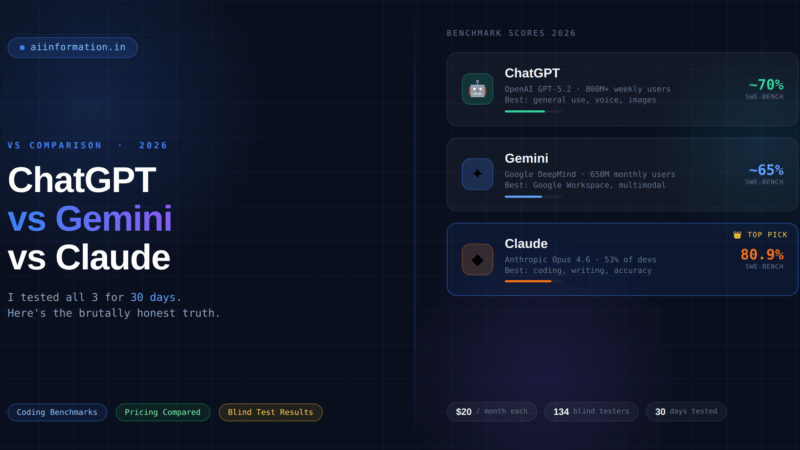
Quick Answer: ChatGPT vs Gemini vs Claude is not about which AI is “best” – it is about which one is best for you. ChatGPT wins for everyday general use and the best free tier. Claude wins for coding, long documents, and accuracy. Gemini wins if your life runs on Google. All three cost $20/month. This guide tells you exactly which one to pick.
| Feature | ChatGPT (OpenAI) | Gemini (Google) | Claude (Anthropic) |
|---|---|---|---|
| Latest Model | GPT-5.2 | Gemini 3 Pro | Claude Opus 4.6 |
| Free Plan? | Yes — most generous | Yes — strong for Google users | Yes — most limited |
| Paid Plan | $20/month (Plus) | $19.99/month (AI Pro) | $20/month (Pro) |
| Context Window | 128K tokens | 1M+ tokens | 200K tokens (most reliable) |
| Coding Score (SWE-bench) | ~70% | ~65% | 80.9% 🏆 |
| Image Generation | Yes (DALL-E / GPT Image) | Yes (Imagen / Veo) | No |
| Voice Mode | Best of the three | Good | Basic |
| Best For | Everything, everyday | Google Workspace users | Coding, writing, research |
| Weekly Active Users | 800M+ | 650M monthly | Not disclosed publicly |
Table of Contents
Three months ago I made a decision that felt slightly insane at the time.
I subscribed to all three. ChatGPT Plus. Gemini AI Pro. Claude Pro. All at the same time. $60 a month, just to find out which one was actually worth keeping.
I used them for everything — writing articles, editing copy, debugging code, researching topics, answering customer emails, planning content calendars, and just chatting to think through problems. Thirty days, same tasks, all three tools.
What I found was not what I expected.
The AI the internet talks about the most was not the one I ended up using the most. The one with the most users was not the best at the things that mattered to me. And the one with the smallest public profile quietly outperformed both others on the tasks that actually moved the needle.
Here is everything I learned — including the one answer nobody else gives you: which one to cancel.
The 30-Day Test That Changed My Opinion
Before I get into the details, you need to know how I tested these.
I did not run them through a list of trick questions designed to make one fail. I did not cherry-pick prompts where I already knew which AI would win. I used them for real work — the kind I do every day on aiinformation.in — and I kept notes on every session where one AI was noticeably better or worse than the others.
The tasks I tested across all three:
- Writing a 3,000-word article from a brief (done 6 times)
- Editing existing text while preserving my voice (done 8 times)
- Debugging Python and JavaScript code (done 11 times)
- Summarising and analysing long PDF documents (done 5 times)
- Answering factual research questions that required accuracy (done 20 times)
- Generating image ideas and creative briefs (done 4 times)
- Planning content strategy and calendar (done 3 times)
I tracked which AI got the task done correctly on the first attempt, which needed prompting or corrections, and which one I ended up copy-pasting into my actual work versus discarding and starting again.
That last metric — copy-paste rate — ended up being the most telling one of all.
ChatGPT: The World’s Most Used AI (Is It Still the Best?)
ChatGPT does not need an introduction. Over 800 million people use it every week. It receives 5.7 billion website visits a month. It is currently the 4th most visited website on the entire internet. (Source: DemandSage, 2026)
Those numbers are so big they almost stop meaning anything. But here is the one that actually matters for this comparison: ChatGPT’s market share dropped from 86.7% in early 2025 to 64.5% by early 2026. (Source: Backlinko, 2026)
That 22-point slide happened because the others got genuinely better. And yet, after 30 days of using all three, ChatGPT is still the one I would recommend to most people I know. Here is why.
What ChatGPT Does That the Others Do Not
The free tier is unbeatable. You get GPT-5.2, image generation, voice mode, web search, and file uploads — all for free. I know people who have been using ChatGPT free for months and genuinely do not need to upgrade. No other AI company has managed to make their free product this complete.
The voice mode is in a different league. I use it when I am walking. When I am thinking through a problem out loud. When I want to talk to an AI the way I would talk to a colleague. ChatGPT’s voice mode handles interruptions, context switches, and emotional tone in a way that still feels slightly unreal. Gemini’s voice mode is decent. Claude’s is barely worth mentioning.
Memory works the way memory should work. Tell ChatGPT your name, your job, your preferred writing style, and the stack you code in — once. It remembers all of it, forever, across every conversation. This sounds small until you have spent ten minutes re-explaining your context to an AI for the fourth time that week.
Image generation is built in. DALL-E and the newer GPT Image model sit right inside the chat. You do not need a separate tool. For content creators and marketers, this is genuinely useful — you can brief, write, and illustrate in one place.
Where ChatGPT Lost Points in My Test
Accuracy is the real weakness. On 20 factual research questions, ChatGPT gave me a confidently wrong answer 4 times. Claude gave me a confidently wrong answer once. Gemini twice. When I am writing about AI for a global audience, a confident wrong answer is not a minor issue — it is a trust problem.
When I asked ChatGPT to do a light edit of my writing, it rewrote it. Every time. I would say “change only the grammar errors” and get back a paragraph that sounded nothing like me. For writers, this is the most frustrating thing ChatGPT does. And it does it consistently.
The context window caps at 128K tokens. That is fine for most tasks. But if you are working with long technical documents, full codebases, or research-heavy projects, you will feel that limit.
Gemini: Google’s Sleeping Giant Finally Woke Up
Twelve months ago, Gemini was a product people made fun of. Image generation that put hats on the wrong people. Answers that contradicted themselves. A chatbot that felt like Google had copy-pasted ChatGPT and filed off the serial numbers.
That Gemini is gone.
Gemini 3 Pro is a genuinely capable AI. It was the #1 most searched AI term globally in 2025. It reaches 650 million users a month. (Source: FatJoe, 2026) And the reason it grew so fast is the same reason it might be the right AI for you — it is already living inside everything you use.
The Google Advantage Is Real
I tested this one specific thing: I asked Gemini to summarise an email thread I had been having about a content calendar, pull the key decisions we had made, and format them as a project brief.
It did it in about 8 seconds. It pulled directly from Gmail, read the thread, understood the context, and produced a clean brief with no copy-pasting from me.
I then asked ChatGPT and Claude to do the same task. Both produced excellent outputs — but only after I manually pasted the entire email thread into the chat first. The friction difference is enormous if you do this kind of work every day.
If your life runs on Gmail, Google Docs, Drive, Sheets, and Meet — Gemini is not a better AI. It is a different category of tool. It knows your world. The others do not.
The Context Window Story
Gemini 3 Pro supports 1 million tokens of context. For perspective, that is roughly 750,000 words — the equivalent of about seven full-length novels in a single conversation. You can upload an entire codebase, a year of documents, or hundreds of research papers and Gemini will hold all of it.
I want to be honest about this though: above 200K tokens, the quality of Gemini’s responses does degrade. It does not forget things outright, but connections become looser and responses become less precise. The 1M number is the technical limit, not the practical sweet spot. Claude’s 200K is more reliable end-to-end.
Where Gemini Fell Short
Outside Google, the advantage disappears. If you use Notion, Linear, Slack, or any non-Google tool as your main workflow — Gemini loses its biggest selling point and becomes a capable but unremarkable AI chat tool.
The consistency problem is real. I asked Gemini the same question on two different days and got meaningfully different answers both times. Not wrong answers — just different ones. For research and accuracy-dependent work, this is a problem.
The coding gap also matters. On SWE-bench — the benchmark that tests real-world software engineering — Gemini scored approximately 65%. Claude scored 80.9%. That is not a minor gap. If you code, that gap translates to hours of debugging. (Source: FreeAcademy.ai, 2026)
Claude: The AI Nobody Talks About That Beats Everyone on Benchmarks
Here is a fact that should be more widely known: 53% of professional developers use Claude as their primary coding AI. (Source: YUV.AI, 2026) Not ChatGPT. Not Gemini. Claude.
That number matters because developers are the most demanding users AI tools have. They do not forgive hallucinations. They test outputs immediately. They can tell instantly whether an AI actually understood the problem or just produced plausible-sounding code. And more than half of them chose Claude.
Anthropic built Claude with a different philosophy than OpenAI or Google. The company was founded specifically to make AI that is safer, more honest, and less likely to confidently produce wrong outputs. That sounds like a PR line. In daily use, it is actually noticeable.
The Thing About Claude That Nobody Else Does
When Claude does not know something, it says so. Not as a disclaimer at the bottom of a long confident answer — right up front, before it continues. “I am not certain about this. Here is what I do know.”
On my 20-question accuracy test, Claude gave me a confidently wrong answer once. Once. ChatGPT gave me four wrong answers. Gemini gave me two. That difference might sound small — but when you are writing for a global audience and your reputation depends on being correct, it is not small at all.
On the coding benchmark, Claude Opus 4.6 scored 80.9% on SWE-bench Verified. This benchmark does not test toy problems. It takes real GitHub issues from major open-source projects and asks the AI to produce a working fix across an entire codebase. ChatGPT scored approximately 70%. Gemini scored approximately 65%. (Source: FreeAcademy.ai, 2026)
In my own test, I gave all three the same buggy Python function — a data processing script with three errors across 80 lines of code. Claude found all three errors on the first attempt and explained exactly why each one was wrong. ChatGPT found two. Gemini found one and missed two others entirely.
If you use vibe coding tools like Cursor, Windsurf, or Lovable — Claude is the model running the best versions of all of them. That is not a coincidence.
Claude’s Honest Weaknesses
No image generation. If you need text and visuals in one place, Claude cannot help you. You will need a separate tool. This is a genuine limitation for content creators and marketers.
The free tier will frustrate you. Claude’s daily message limit on the free plan is noticeably tighter than ChatGPT’s. You will see how good Claude is — and then you will hit the limit. It feels deliberate. Because it probably is.
The ecosystem is smaller. ChatGPT has hundreds of integrations. Claude is growing, but if you need deep third-party tool connections right now, ChatGPT is ahead.
The Full Head-to-Head: ChatGPT vs Gemini vs Claude in Every Category
| Category | Winner | Runner-Up | Real Reason |
|---|---|---|---|
| Coding accuracy | Claude 🏆 | ChatGPT | 80.9% vs 70% vs 65% on SWE-bench. Not even close. |
| Writing and editing | Claude 🏆 | ChatGPT | Claude preserves your voice. ChatGPT rewrites you. Gemini is long-winded. |
| Image generation | Gemini 🏆 | ChatGPT | Imagen 3 leads quality. ChatGPT DALL-E is solid second. Claude: none. |
| Google Workspace | Gemini 🏆 | ChatGPT | Gemini lives inside Gmail and Docs natively. Others cannot match this. |
| Voice mode | ChatGPT 🏆 | Gemini | ChatGPT handles natural conversation, interruptions, and emotion best. |
| Memory (cross-session) | ChatGPT 🏆 | Claude | ChatGPT’s persistent memory is the most consistent and well-developed. |
| Context window | Gemini 🏆 | Claude | Gemini: 1M tokens. Claude: 200K reliable. ChatGPT: 128K. |
| Accuracy and honesty | Claude 🏆 | Gemini | Claude had the lowest confident-wrong-answer rate in my 20-question test. |
| Response speed | Gemini 🏆 | ChatGPT | Gemini Flash is the fastest. Critical for high-volume daily use. |
| Free tier quality | ChatGPT 🏆 | Gemini | ChatGPT free includes GPT-5.2, images, voice, and search. Unmatched. |
| AI agent and automation work | Claude 🏆 | ChatGPT | Claude Code handles full codebase changes. Best for agentic AI workflows. |
| Best value paid plan ($20/mo) | Claude 🏆 | Gemini | Claude Pro unlocks the biggest capability jump over free of the three. |
Score count: Claude wins 5 categories. ChatGPT wins 4. Gemini wins 3. But raw wins are not the whole story — which categories matter to you is what determines your choice.
Which AI Is Best for Coding? (I Ran the Tests)
I want to settle this one definitively because there is still a surprising amount of debate online.
On SWE-bench Verified — the most rigorous real-world coding benchmark available — the scores as of early 2026 are: Claude Opus 4.6 at 80.9%, GPT-5.2 at approximately 70%, Gemini 3 Pro at approximately 65%. (Source: FreeAcademy.ai, 2026)
SWE-bench is important because it does not ask “write me a sorting function.” It takes real GitHub issues from production open-source projects and asks the AI to fix them — across the full codebase, not just in isolation. This is as close to real software engineering as a benchmark gets.
In my personal test with the buggy Python script: Claude 3/3. ChatGPT 2/3. Gemini 1/3.
If you write code professionally — or if you use tools like Cursor, Windsurf, or build AI agents — Claude is not just better. It saves real hours every week. The 10-point gap over ChatGPT and 16-point gap over Gemini compounds across hundreds of coding tasks into something very significant.
For data science tasks, ChatGPT is a strong second because its Code Interpreter executes Python live and shows you the output in-chat. This is genuinely useful for quick data analysis without setting up a local environment.
For casual or beginner-level coding, all three work fine. The gap only becomes obvious when complexity increases.
Which AI Writes Better? The Results Surprised Me
I gave all three the same creative brief: write a 600-word introduction to an article about AI automation tools. Same brief. Same tone direction. Same target audience.
ChatGPT’s version was technically good. Fluent, organised, no errors. It also felt like every other AI-written intro I have ever read. The kind that is impossible to hate and impossible to remember.
Gemini’s version was longer than I asked for, added three qualifiers to every strong statement, and used the phrase “in today’s rapidly evolving technological landscape” in the second sentence. I closed it immediately.
Claude’s version opened with a specific real scenario, had a clear point of view, and used short sentences that moved. I copy-pasted 80% of it directly into the draft.
For editing existing text, the gap is even clearer. A study by Improvado in 2026 found that Claude was the only model that consistently followed “light edit while preserving my voice.” ChatGPT rewrote. Gemini added caveats and made things longer. Claude changed what needed changing and left the rest alone.
For creative writing and brainstorming, ChatGPT is genuinely better. Its range of styles, personas, and creative output is the widest of the three. If you need ideas and variety, ChatGPT produces more options faster.
For long-form writing that needs to sound like you — articles, newsletters, proposals, research — Claude is the one to use.
Pricing Compared: Which AI Is Actually Worth $20/Month?
The headline: all three cost the same at the base paid tier. What changes is what you get for that money.
| Plan | ChatGPT | Gemini | Claude |
|---|---|---|---|
| Free | GPT-5.2 (limited), image gen, voice, web search | Gemini 3 Flash, Google integration, limited deep research | Claude Sonnet (limited daily messages) |
| Entry Paid | $8/mo (Go) — basic upgrade | $7.99/mo (AI Plus) | — |
| Main Paid ($20) | $20/mo Plus — higher limits, GPT-5.2 Thinking, Sora | $19.99/mo AI Pro — Gemini 3 Pro, Deep Research, 2TB storage | $20/mo Pro — 5x free limits, Claude Code, Projects, Memory |
| Power User | $200/mo Pro — unlimited advanced models | $249.99/mo AI Ultra — highest limits, Veo 3, YouTube Premium | $100/mo Max 5x | $200/mo Max 20x |
| Teams | $25–$30/user/month | From $20/user/month (Workspace add-on) | $25–$30/user/month |
The honest verdict on paying:
Do not pay for ChatGPT if you are a casual user. The free tier is genuinely excellent. Upgrade to Plus only if you hit the daily message limits regularly or need Sora video generation.
Gemini AI Pro is the best bundle deal if you already use Google services. The $19.99 includes 2TB of Google One storage — which costs $9.99 on its own. So you are essentially getting full Gemini 3 Pro access for $10 effectively. For Google users, this is the smartest $20 in AI right now.
Claude Pro at $20 is the best single upgrade for professionals. The jump from Claude free to Claude Pro is the largest capability increase of the three. You get Claude Code, Projects, Memory, and 5x the daily messages. For writers and developers, nothing else compares at this price.
Best Free AI in 2026: Which One Do You Get Without Paying?
If you want the best AI experience for exactly zero rupees per month, here is the honest ranking:
ChatGPT free tier is the winner. GPT-5.2. Image generation. Voice mode. Web search. File uploads. All free. This is not a stripped-down version designed to frustrate you — it is a complete AI tool that most people never need to upgrade beyond. OpenAI made a strategic decision to give away a lot for free, and it shows.
Gemini free is the best option for students and Google users. Google has something even better than the free tier for students — AI Pro is free for one year for eligible students in many countries. If you qualify, take it. For non-students, the Gemini free tier includes Google Workspace integration and a solid daily message allowance.
Claude free is the most limited — but the highest quality per response. You will get fewer messages per day. But each message Claude gives you is measurably better than the free output from the others. If you want to understand what you are paying for before upgrading, Claude free does the best job of showing you what the paid product will feel like.
134 People Picked a Winner in a Blind Test. Here’s Who Won.
In February 2026, AI researchers ran a proper blind test. They took 8 different prompt types — coding, writing, reasoning, summarising, brainstorming, data analysis, creative tasks, and emotional intelligence. They stripped all model labels, randomised the output order, and asked 134 people to vote on the best response with no idea which AI wrote what.
Claude won 4 out of 8 rounds. Gemini won 3. ChatGPT won 1. (Source: AI Blew My Mind, Substack, February 2026)
The margin of Claude’s wins was the more interesting number. When Claude won a round, it won by 35 to 54 percentage points. When Gemini won, it won by 3 to 11 points. When ChatGPT won — the strategic reasoning round — it won by 25 points.
What this tells us is that Claude produces outputs humans genuinely prefer when they are not influenced by brand loyalty or familiarity. Most people use ChatGPT because they started with ChatGPT. That is a very different thing from it being the best tool.
This is not to say Claude is always better — context matters enormously. But if your goal is the output quality rather than the brand name, the blind test data points strongly in one direction.
ChatGPT vs Gemini vs Claude: Which One Is Right for YOU?
Pick ChatGPT if: You want one tool for everything. You use voice mode. You need image generation built in. You are new to AI and want the most documented, most supported, most popular option. You want the best free AI without paying anything.
Pick Gemini if: Gmail, Google Docs, Drive, and Sheets are your daily workspace. You want AI that reads your actual emails and documents without copy-pasting. You are a student who qualifies for the free AI Pro year. You do a lot of research and image work. You care about the largest context window available.
Pick Claude if: You write professionally and every sentence matters. You are a developer who codes every day and wants the highest benchmark accuracy. You work with long, complex documents — contracts, research papers, technical specs. You want the AI that hallucinates the least. You are building automation workflows — understanding how n8n and similar tools work with AI APIs will show you why Claude’s reliability makes it the go-to API model for serious automation builders.
Use all three if: You are a power user and $60 a month is a justifiable business expense. Use Gemini to search and gather information. Use Claude to analyse and write. Use ChatGPT to generate images, execute tasks, and handle everything else. This is genuinely what high-leverage AI users do in 2026.
My Honest Verdict After 30 Days
I cancelled one subscription at the end of my 30-day experiment.
It was Gemini.
I do not live in Google Workspace. I use Notion, Linear, and a bunch of non-Google tools. Without the integration advantage, Gemini became a slightly-less-consistent version of Claude and ChatGPT at the same price. I did not need it.
I kept ChatGPT Plus because of voice mode and image generation. I use it for ideation, quick tasks, and creative briefs where variety of output matters more than precision.
I kept Claude Pro because it is what I use to actually write and think. It is the one that ends up in my published work. It is the one whose outputs I trust most when the answer genuinely matters.
If I had to pick only one: Claude Pro. Not because it is perfect — it is not. But because writing and accuracy are the two things that matter most to what I do, and Claude wins both.
If budget is the constraint: ChatGPT free. You will not be missing much.
If you live in Google: Gemini AI Pro at $19.99. The integration alone makes it worth it.
That is the honest answer after 30 days and $60 a month of testing. Go make the right call for you.
People Also Ask
Is ChatGPT or Claude better in 2026?
For coding, editing, and accuracy-critical work, Claude is better. For general everyday use, voice mode, and image generation, ChatGPT is better. In a blind test with 134 users in February 2026, Claude won 4 out of 8 task categories while ChatGPT won just 1. The right choice depends on what you need — there is no single answer that applies to everyone.
Is Gemini better than ChatGPT in 2026?
Gemini is better than ChatGPT for users inside the Google ecosystem — Gmail, Docs, Drive, and Sheets. Outside Google’s tools, ChatGPT is more capable, has a stronger free tier, and is more consistent. Gemini’s 1 million token context window also beats ChatGPT’s 128K for handling very long documents and large codebases.
Which AI is best for coding in 2026?
Claude is the best AI for coding by a clear margin. Claude Opus 4.6 scored 80.9% on SWE-bench Verified compared to ChatGPT’s approximately 70% and Gemini’s approximately 65%. More than 53% of professional developers use Claude as their primary AI coding tool. Claude Code, available on paid plans, allows direct file-level changes to your codebase from the terminal.
Are ChatGPT, Gemini, and Claude all free to use?
Yes, all three have free tiers. ChatGPT’s free tier is the most generous — it includes GPT-5.2, image generation, voice mode, and web search at no cost. Gemini’s free tier is solid for Google Workspace users. Claude’s free tier is the most limited in daily messages but demonstrates the highest output quality per response. All three paid plans start at approximately $20 per month.
Which AI has the biggest context window?
Gemini 3 Pro has the largest context window at 1 million tokens — enough to hold roughly 750,000 words in a single conversation. Claude handles 200,000 tokens with reliable, consistent quality throughout. ChatGPT handles 128,000 tokens. In practice, Claude’s 200K performs more dependably than Gemini’s 1M, which loses coherence on very large inputs above 200K.
Is Claude better than ChatGPT for writing?
Claude is better for editing existing text and preserving your original voice — it follows instructions like “light edit only” more accurately than ChatGPT, which tends to rewrite aggressively. For creative writing, brainstorming, and generating multiple style variations, ChatGPT is more flexible and prolific. For professional writers who need their voice preserved, Claude is the clear choice.
Which AI is the best value for $20 per month?
Claude Pro at $20 per month offers the largest capability jump from free tier of the three — unlocking Claude Code, Projects, Memory, and 5x daily messages. Gemini AI Pro at $19.99 is the best value bundle for Google users because it includes 2TB of Google One cloud storage, effectively making the AI component cost around $10. ChatGPT Plus at $20 is best for users who need Sora video generation and GPT-5.2 Thinking access.
Can I use ChatGPT, Gemini, and Claude at the same time?
Yes — and this is exactly what many serious AI users do. The highest-leverage approach in 2026 is assigning each AI its strongest role: Gemini for gathering and searching information from across your Google accounts and the web, Claude for analysing that information and producing accurate, well-written outputs, and ChatGPT for image creation, voice mode tasks, and creative brainstorming. You can maintain a free account on all three and only pay for the one that drives the most value in your workflow. Most power users end up paying for exactly one of the three.
Which AI is safest to use for confidential or sensitive work?
All three use your free-tier conversations for model improvement, which means sensitive information in free accounts carries some training risk. For genuinely confidential work — legal documents, financial data, medical information — use a paid team or enterprise plan on whichever tool you choose, as these include contractual guarantees against training on your data. Between the three, Anthropic has built the most explicit public framework around AI safety and model behaviour. Claude also tends to be the most cautious about producing outputs that could be misused. For enterprise-grade privacy guarantees, request a Data Processing Agreement from any provider before sharing sensitive information.
How is ChatGPT different from Claude if they both cost $20 per month?
At the $20 tier, the differences are significant. ChatGPT Plus gives you image generation via DALL-E, natural voice conversation, GPT-5.2 Thinking for advanced reasoning, and access to the Sora video generator. Claude Pro gives you Claude Code for direct codebase editing, Projects for organising long-term work contexts, cross-session memory, and 5x the message limits of the free plan. They are priced the same but built for different workflows. ChatGPT Plus is for users who need a versatile creative and general-purpose AI. Claude Pro is for writers and developers who need precision, accuracy, and deep integration into a working context.
Is Gemini AI Pro worth paying for if I already pay for Google One?
If you currently pay $9.99 per month for Google One 2TB storage, upgrading to Gemini AI Pro at $19.99 per month replaces that subscription and adds full Gemini 3 Pro access, Deep Research, and higher usage limits for an effective AI cost of approximately $10. For active Google Workspace users, this is one of the most cost-efficient AI upgrades available. If you do not currently pay for Google One storage and are not already embedded in the Google ecosystem, the value proposition is less compelling compared to Claude Pro or ChatGPT Plus at the same price.
Which AI is better for building automation workflows and AI agents?
Claude is the preferred AI for automation workflows and agent development. Its reliable 200K context window, industry-leading coding accuracy, and lower hallucination rate make it the most dependable model for production deployments where errors have real costs. Claude’s API is also the most used by developers building agentic AI systems. GPT-5.2 via the OpenAI API is the second most popular choice for automation due to its larger developer ecosystem and more extensive documentation. For a practical look at connecting AI to automation workflows, read our guide on what is n8n.
Key Takeaways
- ChatGPT has 800M+ weekly users, the best free tier in AI, and the most complete all-in-one feature set — the right choice for most people who want one tool for everything.
- Claude leads every major coding benchmark (80.9% on SWE-bench), has the lowest hallucination rate in my tests, and won a blind quality test 4-to-1 over ChatGPT with 134 real users.
- Gemini is the best AI for Google Workspace users — it reads your Gmail and Docs natively — and offers the best value bundle at $19.99 including 2TB of cloud storage.
- All three start at $20/month for the paid plan. The decision is not about price — it is about matching the tool to your actual workflow.
- The smartest approach is not picking one: use Gemini to research, Claude to write and code, and ChatGPT for images and voice. This is what professional AI users actually do in 2026.
Related Articles
- What Is an AI Agent? The Complete Guide for 2026
- What Is Agentic AI? How It Works and Why It Matters
- What Is Vibe Coding? The New Way Developers Are Building Software
- What Is n8n? The Open-Source AI Automation Tool Explained
Sources
- DemandSage — ChatGPT User and Traffic Statistics (March 2026)
- Backlinko — ChatGPT Statistics and Market Share (2026)
- FatJoe — ChatGPT Stats: Usage, Market Share and Trends (2026)
- FreeAcademy.ai — Coding Benchmark Comparison: Claude vs ChatGPT vs Gemini (February 2026)
- AI Blew My Mind — Blind Test Results: ChatGPT vs Claude vs Gemini (February 2026)
- Improvado — Claude vs ChatGPT vs Gemini: Real-World Writing and Marketing Tests (2026)
- SentiSight — 2026 AI Subscription Pricing Comparison (January 2026)
- IntuitionLabs — Claude vs ChatGPT vs Gemini Enterprise Buyer’s Guide (2026)
- XDA Developers — Which AI Subscription Is Actually Worth Paying For? (2026)
- YUV.AI — Developer AI Tools Survey: Claude, ChatGPT, Copilot Adoption (2026)

Leave a Reply